

When planning an industrial cooling system, one of the most important decisions is whether to choose air cooled chillers or water cooled chillers.
Although the two types of chillers play an integral role in modern industrial cooling systems, it is important to understand key aspects about them.
From working principle, condenser type, noise level, service lifespan to chilling efficiency – they will help you make an informed decision.
What is Air-Cooled Chiller?
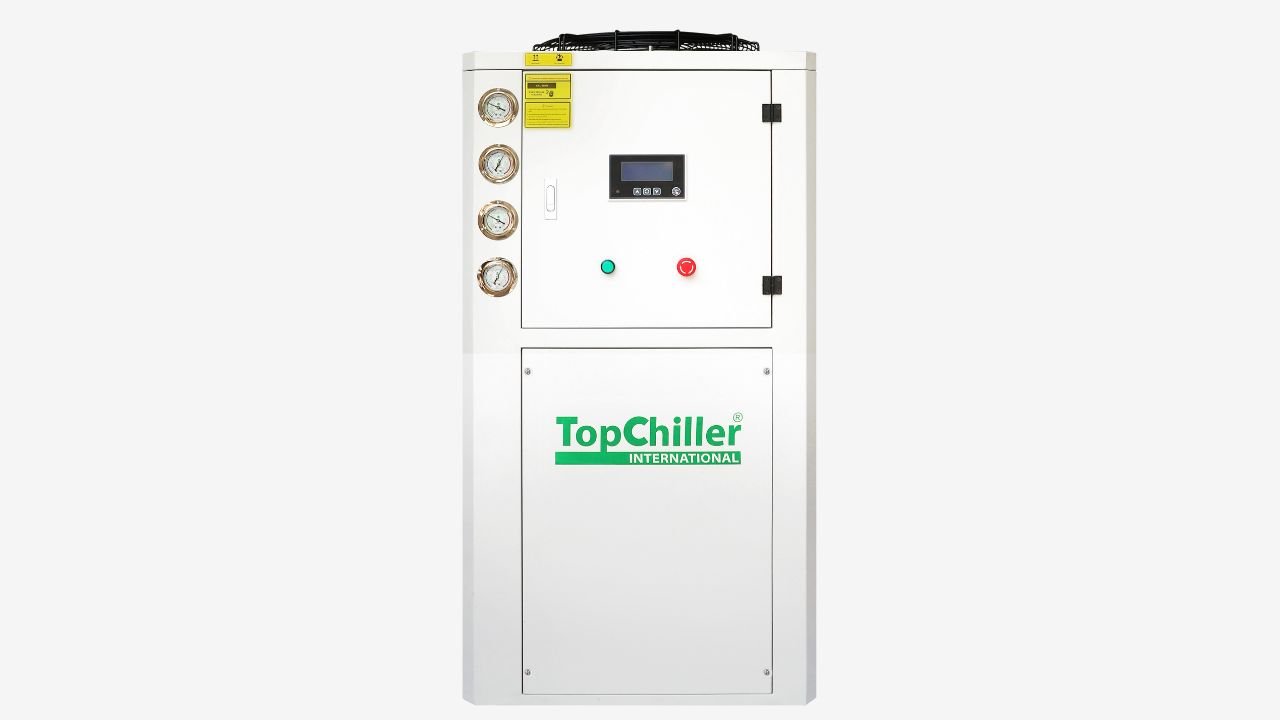
Air-cooled chillers are self-contained systems that remove heat from refrigerant using air. During their cooling process, a combination of fans that blow surrounding air across the condenser coils. As a result, this cools refrigerant, which then flows around the system to absorb heat in various industrial processes.
What is Water-Cooled Chiller?
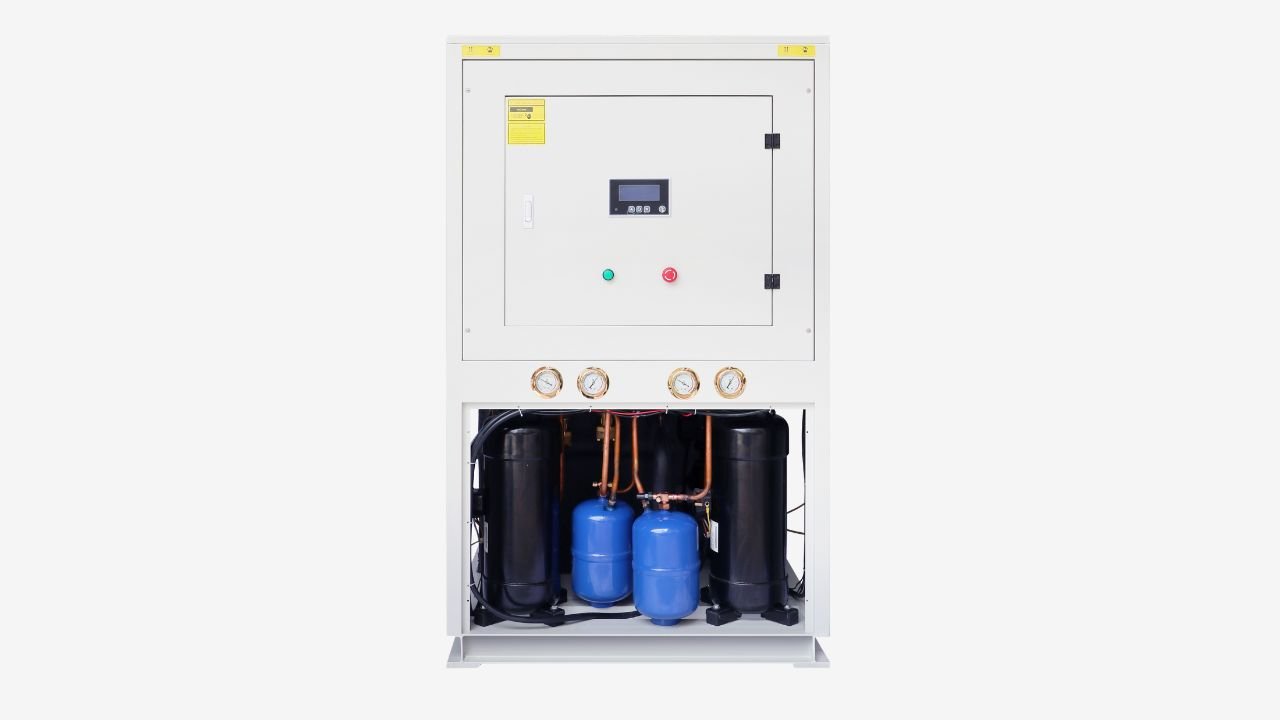
Unlike air-cooled chillers, water-cooled chillers use water to extract heat from the refrigerant and links to a cooling tower.
The water-cooled chiller tower facilitates the heat rejection process. From the secondary water cooling loop, it releases this heat into the atmosphere.
Comparing Air-Cooled and Water-Cooled Chillers – Performance & Cost
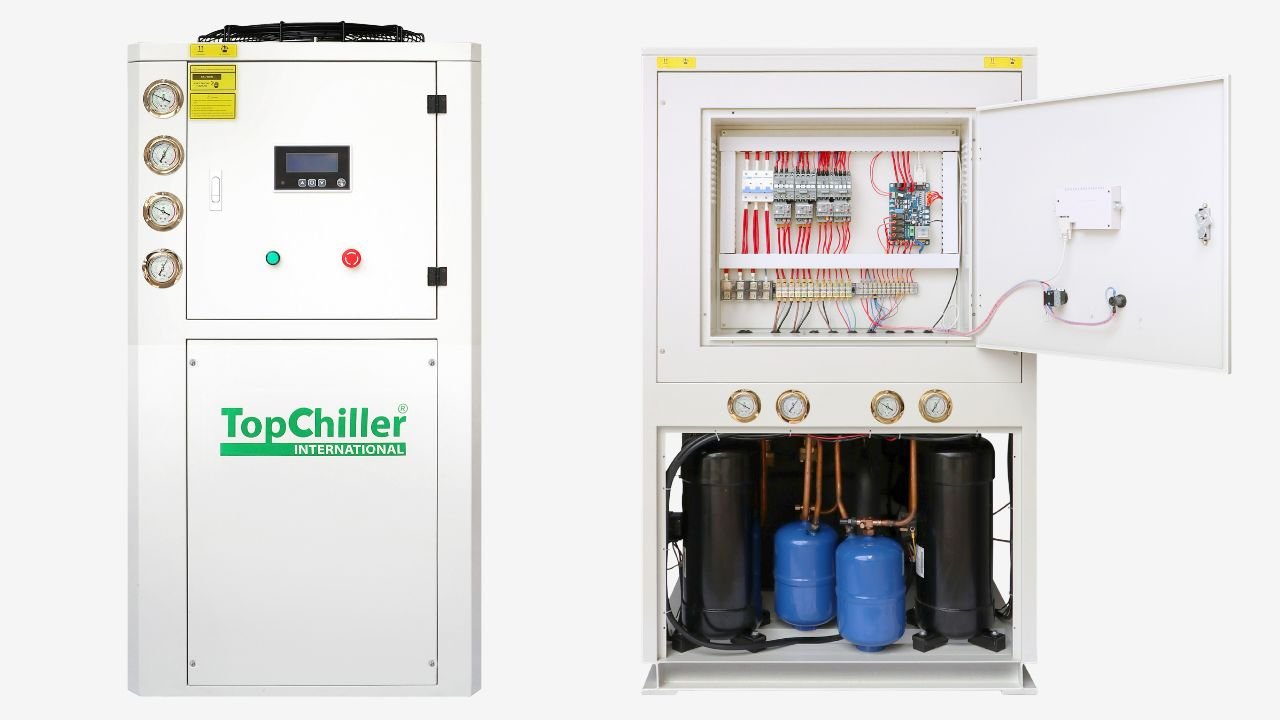
Whether to choose air-cooled chillers or water-cooled chillers is determined by unique performance criteria. Of course, the efficiency in the cooling systems and operational costs play an integral role here.
Let’s explore every aspect to help you make informed decisions when choosing a chiller for industrial cooling system.
· Condenser Type
Like the name suggests, air-cooled chillers uses a stream of air to achieve the cooling effect for your systems.
On the other hand, water-cooled chillers use a combination of water and cooling tower for effective cooling.
Remember water has a specific heat transfer of 4.186 J/g°C. On the other hand, air has a specific heat transfer of 1.012 J/g°C. This makes water-cooled chillers a perfect choice for high-ambient temperatures.
· Working Principle
In air-cooled systems, refrigerant flows through air-exposed condenser coils. Fans pull ambient air to pull out heat, discharging the heat into the atmosphere.
In water-cooled chillers, water absorbs heat from refrigerant in a heat exchanger and carries it to a cooling tower. This makes water-cooled chillers more efficient, especially in high-load or high-temperature industrial applications.
· Cost (Initial Investment & Operational)
Air-cooled chillers are more affordable to operate than water-cooled chillers. Additionally, they are also simple to install.
On the other hand, water-cooled chillers come with higher initial investment cost but with low operational costs. This makes them a perfect choice for long-term operation.
· Capacity
Water-cooled chillers can handle higher cooling capacity than air-cooled chillers. It is for this reason that you will find a water cooling option for large industrial cooling systems.
For small cooling system, you should consider air-cooled chillers. They are a suitable choice for small to medium scale factories.
· Installation Location
Air-cooled chilling systems are perfect for outdoor installation. Remember, these chillers release heat directly into the atmosphere. Such installation will save space in room where you can install other equipment.
With sufficient ventilation and space, you can install these chillers indoors. However, you must have enough ventilation space for its accessories such as pipes, pumps, and cooling towers.
· Service Lifespan
Water-cooled chillers are longer-lasting than air-cooled chillers. A well-maintained water-cooled unit will perform satisfactorily for 25 to 30 years.
Air-cooled chillers last 15 to 20 years because their components are exposed directly to the outdoors and temperature changes.
Your maintenance routine and conditions have a great effect on each chiller’s lifespan.
· Noise Level
Air-cooled chillers are noisier due to the huge fans used to move air. They can be quite unsuitable for indoor spaces or noise-restricted buildings.
Water-cooled chillers are quieter since their heat rejection is via flow of water and towers, and not fans.
If silent running is needed, water-cooled units are your better choice.
· Compactness & Flexibility
Air-cooled chillers offer space-saving designs best suited for rooftop or outdoor mounting. They are easy to relocate or increase in size when your plant’s cooling demands change.
Owing to the accessories like the cooling towers, water-cooled chillers require large space. Additionally, the accessories makes relocation a cumbersome task.
The best part, there are modular designs you can choose for your industrial cooling systems.
· Chiller System Efficiency
Water-cooled chillers are more energy-efficient. This is largely attributed to the heat transfer properties of water.
Air-cooled chillers are less efficient at higher ambient temperatures since air is a poorer heat extractor.
· Common Applications
Air-cooled chillers are typically used in medium-sized industries. These many include plastic injection molding factories, data centers, and HVAC systems. They are suitable for seasonal applications or water-deficient installations.
Water-cooled chillers are suitable for large factories like power plants, refineries, and continuous production lines.
Quick Comparison on the Best Chillers for Industrial Cooling
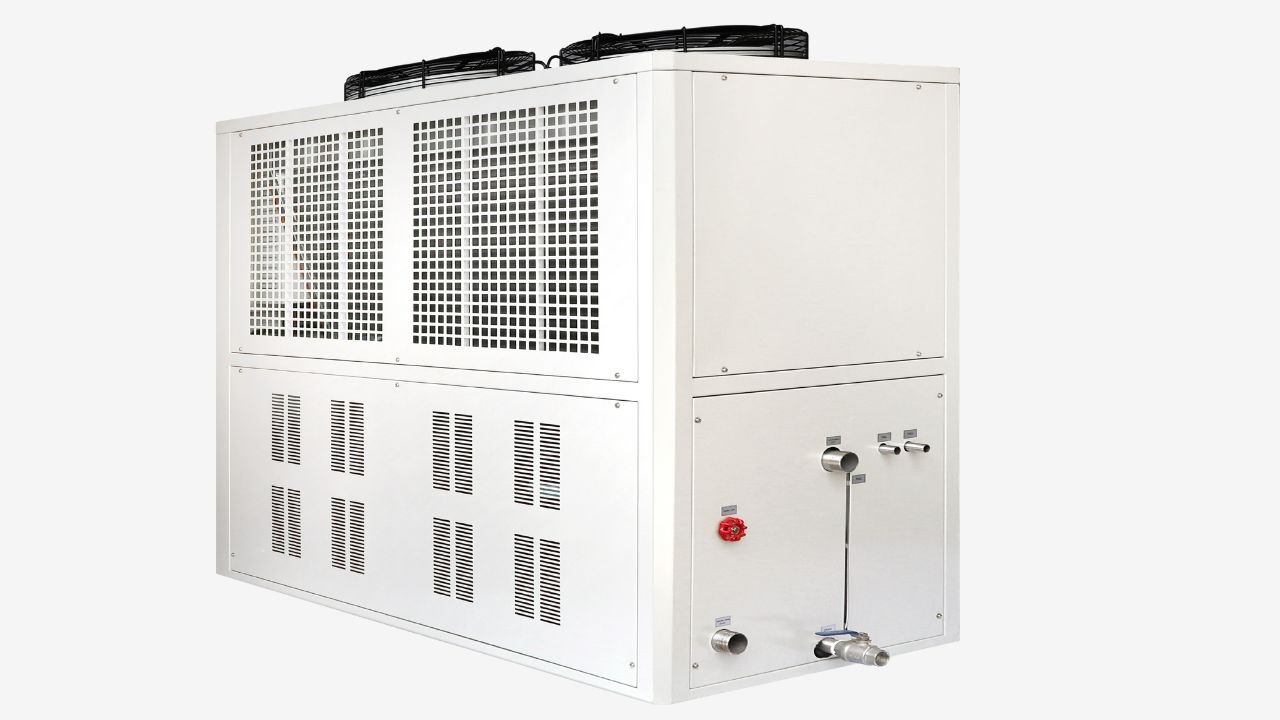
| Features | Water-cooled Chiller | Air-cooled Chiller |
| Initial cost | Higher due to installation and cooling tower requirements | Lower since no cooling tower is needed |
| Efficiency | More efficient, especially for large-scale operations | Less efficient in hot climates |
| Noise level | Quieter due to water cooling | Louder due to condenser fans |
| Size (Space requirements) | Takes more tower and indoor space | Small, ideal for rooftops |
| Lifespan | More typically 25–30 years with proper maintenance | Shorter typically 15–20 years with weather exposure |
| Cooling performance | Good, consistent across conditions | Average varies with ambient temperature |
| Maintenance | Regular water treatment and washing of towers necessary | Little maintenance and simple servicing |
Conclusion

In selecting air-cooled and water-cooled chillers, your building needs, budget, and environment determine what is ideal for you. In the event that you prefer an effortless, outside, low-maintenance setup, go for an air-cooled chiller.
If you want energy efficiency, long-term, and continuous large-scale cooling, go for a water-cooled chiller.
At ChillerOne, we offer a wide range of air-cooled and water-cooled chillers, customized to your unique cooling requirements – Get a quote now.
FAQs
Which is better; air-cooled chillers or water-cooled chillers?
No chiller is better than the other – it depends on your cooling requirements and specifications. For instance, for large and continuous chilling, go for water-cooled chillers. On the other hand, for small to medium cooling requirements, choose air-cooled chillers.
What are the disadvantages of water-cooled chillers?
They require cooling towers, frequent maintenance services, and a continuous supply of water, which makes them expensive to operate and install.
What are the disadvantages of air-cooled chillers?
For hot climates, there generate excessively high noise levels and require more power, compared to water-cooled chiller systems.
How does air-cooled vs water-cooled chillers cost compare?
Air-cooled chillers are less expensive to buy, but they are more expensive to operate in the long run.
Water-cooled chillers are more expensive in the short run, but more energy saving in the long run.
What is the lifespan of an air-cooled chiller?
On average, they can last between 15 to 20 years, however this will vary based on the working condition, and maintenance schedule.
What is the difference between air-cooled chiller and water-cooled chiller?
Air cooled chillers cool with the help of air and fans, whereas water cooled chillers cool with the help of water pumped in the cooling tower.


 English
 Spanish
 Arabic
 Vietnamese

