

Evaporator design determines the efficiency of the chiller system. That is, you can use it to determine the effectiveness in transferring heat, the volume of refrigerant required, its stability under different loads, and its ease of maintenance.
As a matter of facts, we have different types of evaporator designs based on their application environment and cooling requirements. Let’s have a detailed look at the diverse types and all that they entail.
What Is A Chiller Evaporator?

We can describe it as a heat exchanger in which refrigerant takes the heat out of water (or glycol-water mixture), and evaporates, creating a cooling effect. The evaporator acts as some sort of separation point between the chilled water system and the refrigerant circuit, allowing the exchange of heat between both fluids.
Simply put, we can call it the ‘cooling engine’ of the chiller. Its performance has a direct impact on the efficiency of the whole system, its energy usage, and its dependability.
Main Types Of Chiller Evaporators
We have several types of evaporators based on design and application area. Let us take a deep dive into some of them:
1. Shell And Tube Evaporators
Shell and tube is arguably one of the most commonly used evaporators, both commercially and industrially, despite it being the oldest. Its design has a cylindrical shell containing several tubes that convey the chilled water while the refrigerant flows around the tubes within the shell.
How it works
As the water passes through the tubes within the shell, the refrigerant cools it while passing through the outer shell by absorbing heat through the surfaces of the tubes. The refrigerant then evaporates after absorbing the heat.
The vapor produced is then transferred to the compressor, where it is processed further. The design of this evaporator has baffles used to guide the refrigerant flow while increasing the contact area of heat to maximum.
Advantages
- They can work under high temperatures and pressure, meaning you can use them in applications with fluctuating operating conditions.
- Since you can easily take out the tube bundle for inspection and replacement, it is very easy to maintain and clean it.
- They offer a high heat-transfer efficiency, especially when you combine them with internally grooved tubes that increase the contact surface.
- Since they have a large structure and design, they can sustain very high cooling loads because they can efficiently sustain high flow rates.
Disadvantages
- Due to their large structure and design, they consume a lot of space; therefore, unsuitable for applications with limited space.
- Their cost of manufacture and acquisition may be higher due to their size, complexity of design, and materials required.
- You need to regularly clean the tubes; otherwise, scaling and fouling that forms may greatly reduce the heat-transfer effect.
- Corrosions may puncture the tubes, increasing the risk of the refrigerant leaking into the chilled water. This is largely caused by poor water treatment.
Applications
They work best in industrial processing plants, as well as large central HVAC installations. They are also favored in applications where the quality of water is not ideal, since they are more tolerant of sediment and impurities compared to plate evaporators.
2. Flooded Evaporators
We can describe its design as a variation of the shell-and-tube type, but with the refrigerant submerging the tubes. This is strategic since it ensures the tube surface and the refrigerant have maximum contact, maximizing the heat transfer.
How it works
A restricted level of liquid refrigerant is enclosed in the tubes and removes the heat absorbed from boiling water that passes through them. The design guarantees a high heat-transfer efficiency due to the extensive contact between the tubes and the refrigerant.
Advantages
- Their heat transfer efficiency is very high due to the extensive surface contact.
- They can operate efficiently at full load, therefore suitable for applications with constant demand.
- You can carefully control the refrigerant level, therefore giving you control of a wide range of operating temperatures.
Disadvantages
- They are expensive to maintain since you will require complicated control systems that have pumps, sensors, and more.
- Due to their high refrigerant charge, it will cost you more to operate, and a leak may negatively impact the environment.
- They are prone to oil accumulation, which tends to reduce the effectiveness of heat transfer.
Application
They work best in large centrifugal chillers. They are also recommended in applications that require stable cooling, such as data centers and different industrial facilities.
3. Direct Expansion (DX) Evaporators
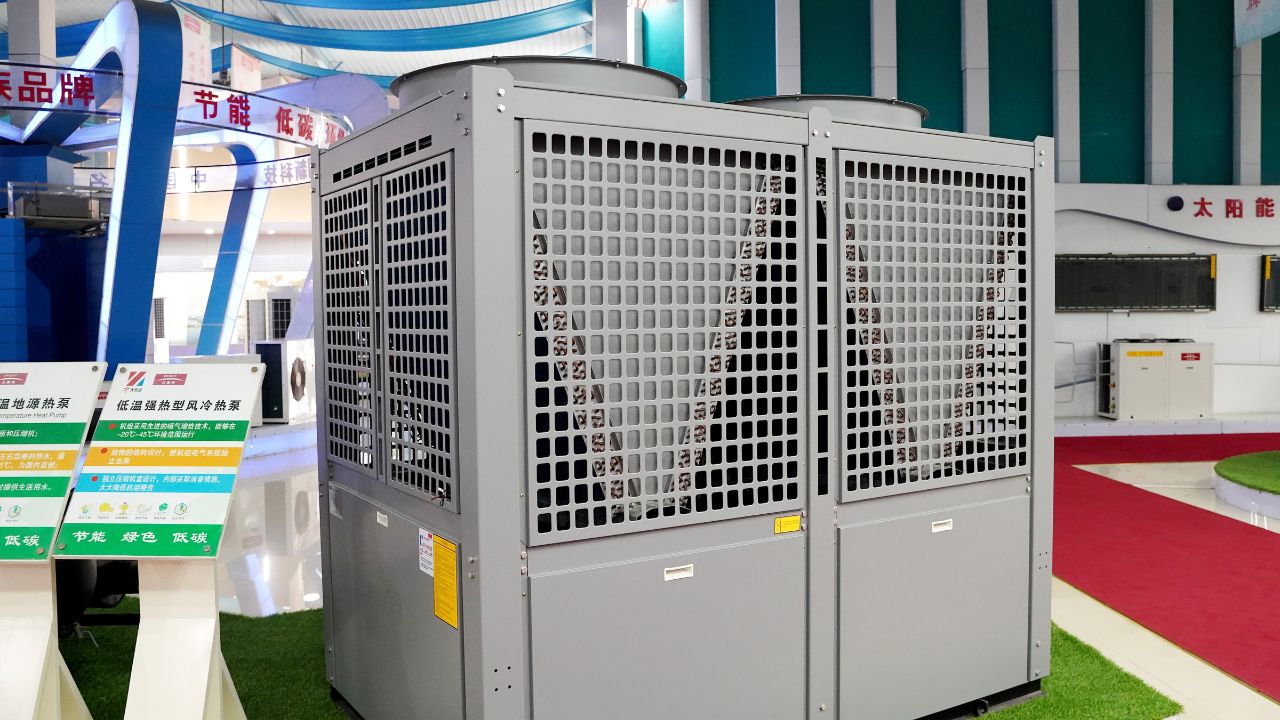
Unlike flooded evaporators, this type has the refrigerant pumped in the tubes with water circulating through the tubes. This system is not complex since the refrigerant evaporates within the tube as opposed to around it.
How it works
Under low pressure, the refrigerant goes through an expansion valve into the tubes and absorbs heat from the water while it evaporates. The resultant vapor is directed into the compressor, and the cycle continues.
Advantages
- Their low refrigerant charge makes them environmentally friendly and easy to install
- They can easily adjust to extreme load variations since the refrigerant boils within the tubes.
- Because of their less complex design, they take up a small space, and you can easily install them at a friendly cost.
Disadvantages
- Some multi-circuit designs are prone to refrigerant flow problems that reduce efficiency.
- They do not work well with part-loads since the refrigerant does not evenly coat the tube surface.
- They are susceptible to oil film deposition that may decrease heat transfer efficiency.
Applications
Based on their compact size and simplicity, they work best with modular cooling systems and rooftop chillers. They cost much less and fit well in constrained-space applications.
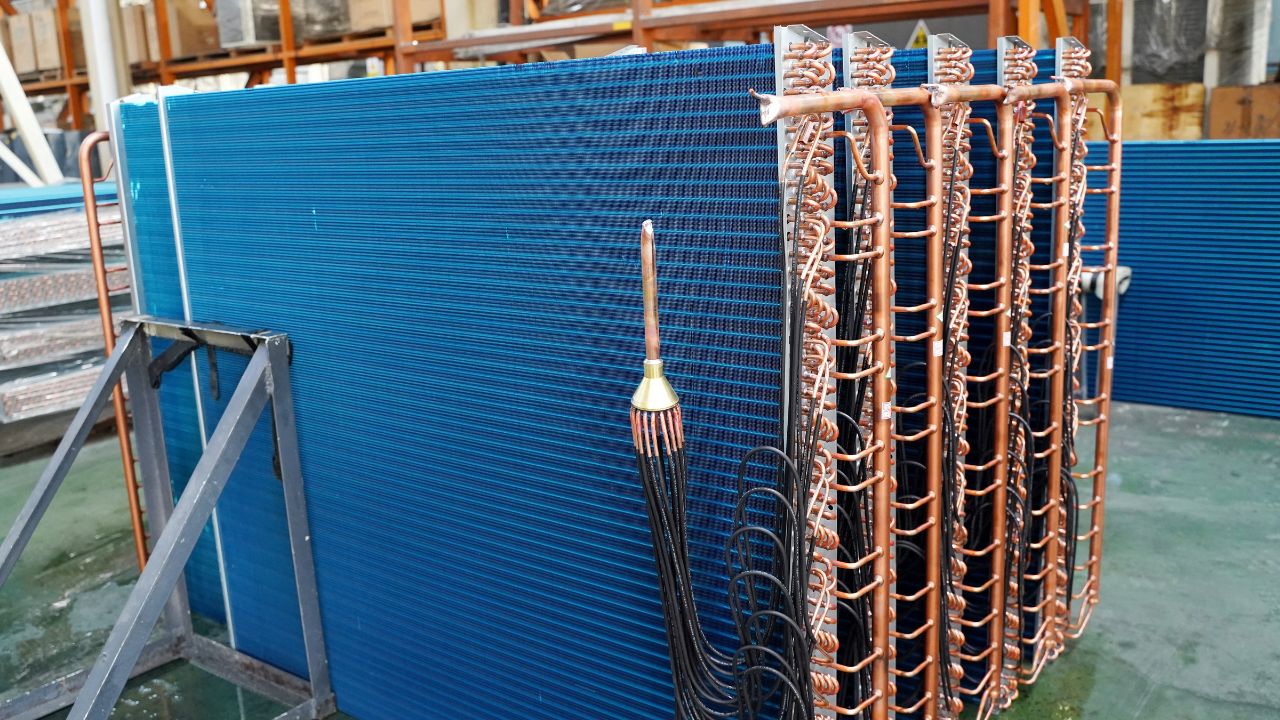
4. Finned Tube Evaporator
How it works
Designed with refrigerant-carrying tubes that are fitted with metal fins on their outer surfaces to enhance the effective heat-transfer surface. Air or other fluid is passed over the fins, and some heat is passed on to the refrigerant in the tubes, which in turn evaporates and results in the cooling effect.
Advantages
- Its fins enhance heat transfer by increasing the exposed surface area.
- They are not very complex in design and construction, hence they are cost-effective and simple to produce.
- They are suitable for air-cooled systems in which the usage of water has to be minimized or is zero.
Disadvantages
- It has low efficiency in heat transfer compared to that of water-cooled evaporators, like flooded or plate-based
- Airflow is a key factor in the performance of turbine engines, and therefore, dirty or blocked fins can greatly decrease the efficiency of a turbine engine.
- The fins may be challenging to disinfect and may take time, particularly in areas with high levels of contamination.
Applications
We mostly apply them in air-cooled chillers or in areas where water is scarce. You may also apply them in HVAC rooftop systems and commercial refrigeration.
5. Tube-in-Tube Evaporator
How it works
This design has one tube fitted inside another, creating two flow streams of heat exchange with the refrigerant forced through the inner tube and water or glycol through the annular gap between the two tubes. The heat is transferred through the wall of the tubes, evaporating the refrigerant.
Advantages
- They are smaller and do not need a lot of space for installations
- They can withstand different water qualities compared with plate evaporators due to their large flow passages.
- They are comparatively cheap to produce and economical for small to medium capacities.
Disadvantages
- The surface area is limited, hence efficiency in heat-transfer is less compared to flooded evaporators.
- Cleaning them is a challenge since internal surfaces are not easily reachable.
- They have low capacity and therefore cannot be used in large-scale industrial chillers.
- Internal tubes may leak and clog, making repairs expensive.
Applications
You will find their application mostly in geothermal systems, domestic use, and light commercial HVAC
6. Plate Heat Exchanger Evaporator
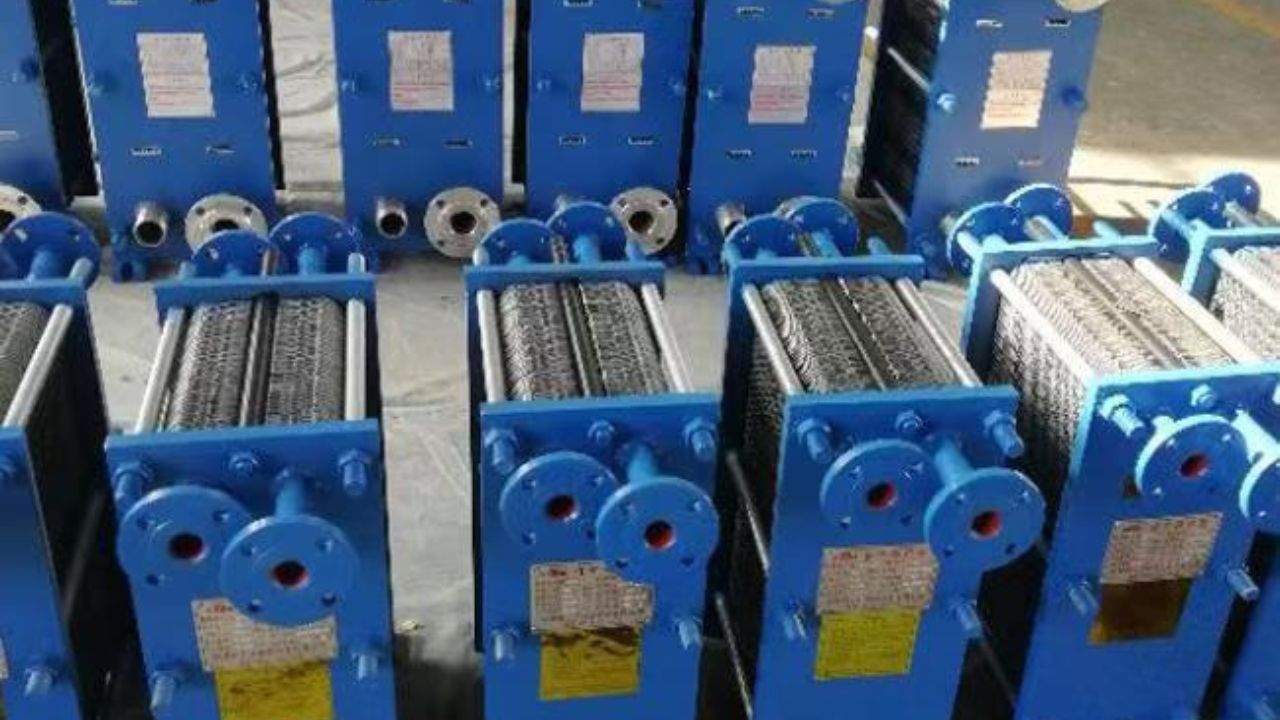
Plate heat exchanger design involves thin stainless-steel plates that are stacked to form a frame that can be used to run water and refrigerant alternately through all channels formed. The great surface area of the plates and the turbulent flow of the liquid in the small channels offer high efficiency in terms of heat transfer.
How it works
Water and refrigerant circulate in alternate channels with thin metallic plates, thus ensuring heat transfer through the surfaces of the plates. The wavy system of the plates incurs high turbulence at low flow rates, enhancing efficiency and minimizing temperature variations between fluids.
Advantages
- Their corrugated plate structure design offers an extremely good heat transfer efficiency due to the maximization of the contact surface area.
- They can easily fit in small-packaged chillers due to their remarkably small size, without compromising on performance.
- The efficiency of their whole system is enhanced by the fact that they can operate with very minimal refrigerant charge.
Disadvantages
- Since their internal passages are small, they can easily clog, hence requiring regular water filtration.
- Their small and compact nature cannot allow you to open and clean manually, therefore requiring cleaning by flushing.
- They cannot sustain large industrial-capacity processes, therefore limiting their application.
- The fact that the small pipe channels are narrow means they can freeze and break in extremely cold operational environments
Applications
You will find them commonly applied in food processing firms and contemporary commercial chillers. Such systems require a regular supply of well-treated water.
Comparison Between Evaporator Types
| Evaporator Type | Efficiency | Refrigerant Charge | Application | Maintenance Level |
| Shell and Tube | Medium | Medium | Industrial | Medium |
| Flooded | Very High | High | High-capacity chillers | Medium-high |
| Direct Expansion | Medium-low | Low | Small chillers | Low-Medium |
| Finned Tube | Medium | Low | Small to medium chillers | Low-Medium |
| Tube-in-Tube | Medium-high | Small water-cooled chillers | Low-medium | |
| Plate Heat Exchanger | High | Low | High-efficiency applications | High (requires well-sanitized water) |
FAQs
Which are the most common types of flow configurations in chiller evaporator systems
In mot cases, you may find on to three flow configurations. Usually, we use one-pass for low cooling loads while multiple passed where the load is higher. That is, higher flow configurations increases heat transfer capacity and cooling efficiency.
Which is the best evaporator for industrial chillers?
For most heavy duty cooling applications, shell and tube offer an efficient and reliable cooling solution. However, you can also find either coil or plate for small commercial cooling systems.
How do calculate the cooling capacity of chiller evaporator?
You can use the formula: Q=m˙×Cp×ΔT
Where:
- Q is the heat load
- m˙ represents the mass flow rate
- Cp is the specific heat of water
- ΔT is the temperature difference between water that enters the evaporators and that leaving the evaporator system
What causes freeze up in evaporator?
It is attributed to low refrigerant, faulty expansion valve or low water flow.
Chillerone is Your Trusted Chiller Evaporator Manufacturer in China
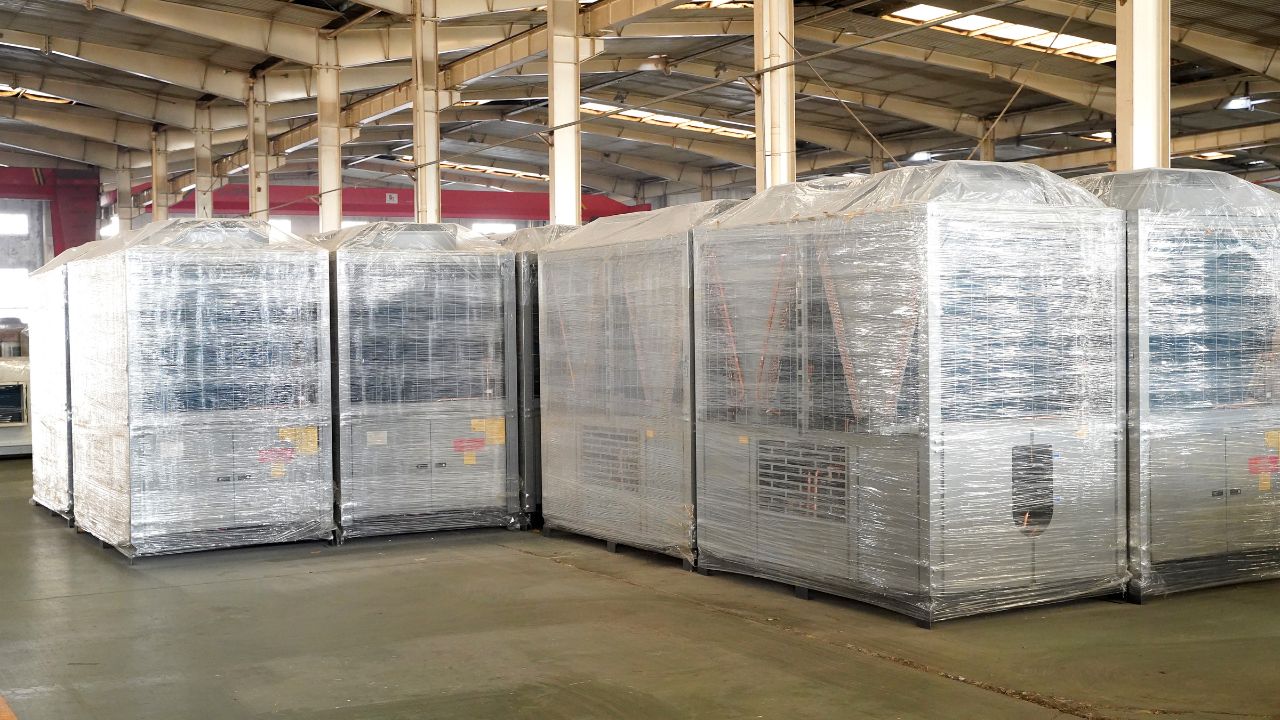
At Chillerone, we will help you choose a suitable chiller evaporator for your system. Once you have details of the available chiller types, our engineers will guide you throughout the entire process based on your cooling requirements, load profile, budget, and space.
For over 12 years, we have been designing chiller evaporator systems for clients in the U.S.A. and Europe. Our focus is to optimize your process operations – Get a complete product catalogue now.


 English
 Spanish
 Arabic
 Vietnamese

