


International Brands We Collaborate With


Features of Chiller for Ice-Making Machine
- Programmable logic controllers (PLC) and human-machine interfaces (HMI) provide automated operation, precise temperature control, and fault alerts.
- Automatic cleaning modes and drainage functions simplify maintenance work and ensure the hygiene of ice production.
- IoT (Internet of Things) functionality enables remote access control and performance monitoring.
- efficient compressors, optimized heat exchange, and the use of natural refrigerants help reduce the kilowatt-hour consumption per pound of ice.
- Components in contact with food and the main frame are usually made of food-grade stainless steel.
- Some have the function of adjusting the ice layer thickness to meet different application requirements
The Reliable Heartbeat from Chillerone—Power Your Business with Ice
High-quality ice is the protector of the flavor of your beverages, the preservation of ingredients, the stability of the production process and so on. Chillerone ice-making machine chillers can quickly produce ice to meet peak demands, efficiently save energy to secure profits. The strict design of our chillers ensures ongoing operation without downtime. With the global proven reliability and local rapid service support, we have the confidence to eliminate your worries about cooling. Choose Chillerone, choose your reliable ice solution.
Types of Chillers for Ice-Making Machine By Cooling Methods/Condenser Type
Chillers can be generally categorized into air-cooled and water-cooled types, according to the difference in rejecting heat.

An air-cooled ice-making machine chiller uses surrounding air to eliminate the waste heat generated during the ice-making process. Its water usage efficiency is high, using only the amount of water required for making ice cubes. Compared with a water-cooled one, it can significantly reduce water and sewage charges.

A water-cooled ice-making machine chiller uses water as the main medium to absorb and dissipate waste heat during the ice-making process. Unlike air-cooled systems, it cools the hot refrigerant gas in the condenser through the circulation of water. By comparison, it is more energy-efficient.
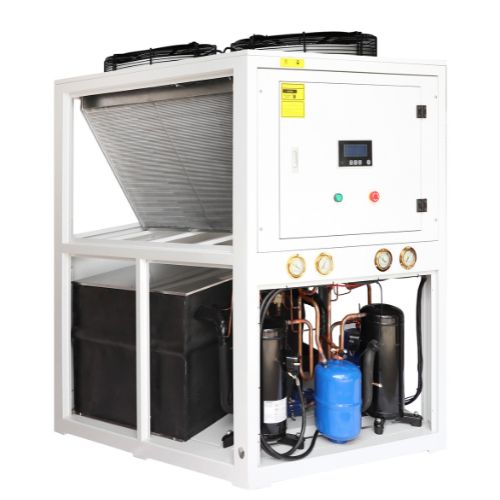
In a direct cooling chiller, the refrigerant directly evaporates in the ice-making evaporator, absorbing the heat from the water (either sprayed or flowing over the surface) and causing it to freeze. The ice-making process is fast and the integration degree of the unit is high.

In the indirect cooling chiller, the water chiller first cools the coolant, and then the low-temperature coolant is used to cool the water to cause it to freeze. The system is relatively independent and conducive to large-scale development.
Types of Chillers for Ice-Making Machine By Compressor Type

A scroll ice-making machine chiller uses scroll compressors to compress the refrigerant to cool. It has a compact structure, smooth operation, low noise, and high efficiency, which is often applied in commercial and light-industrial ice-making.

The screw ice-making machine chiller uses one or two spiral-shaped rotors to compress the refrigerant gas. It has a wide power range, stable operation, long lifespan, suitable for medium and large-sized cooling capacity requirements, such as large commercial ice factories, food processing facilities, and even skating rinks, etc.

A centrifugal ice-making machine chiller is an industrial-scale refrigeration system that generates a large amount of cooling capacity through a high-speed rotating impeller. It has high cooling capacity, high efficiency, suitable for super-large refrigeration systems, such as large commercial ice-making facilities, regional cooling systems, and ice storage systems in large buildings.
Reliable Certification
Equipped with complete global certifications, our chillers follow international regulations to deliver consistent cooling for ice-making machines.


Ice-Making Machine Chiller Applications

Food processing is a typical application of ice-making machine chillers. The chiller helps preserve catches on fishing vessels and fresh seafood. It can also quickly cool meat, poultry, and seafood to prevent bacterial growth and ensure safety and quality during processing.

The ice-making machine chiller can pre-cool fresh agricultural products, including fruits and vegetables, or quickly remove field heat (The residual heat carried by agricultural products after they are harvested in the fields) to extend their shelf life during transportation and storage.

Hotels, restaurants, and catering services always use ice-making machine chillers to ensure the production of ice cubes for beverages, cocktails, salad bars, and attractive food displays.

The ice-making machine chiller is also widely applied in breweries and wineries to adjust temperatures during fermentation and storage to ensure product quality and consistency.

The ice-making machine chiller helps produce soft sheet-like or small block-like ice packs, which are used for cold therapy, pain relief, and providing water supplementation for patients with swallowing difficulties.

The ice-making machine chiller maintains an accurate low-temperature environment for the preservation of vaccines, medications, blood samples, and even organs for transplantation.

The ice-making machine chiller can provide an ice bath environment for experiments and store biological samples and specimens.

The ice-making machine chiller provides stable production of ice that can be directly added to concrete in hot weather to slow down the hardening process, prevent cracking, and ensure the structural integrity of large buildings.

The ice-making machine chiller helps large-scale commercial production of various types of ice for sale and distribution, such as block, sheet, cube, etc.

The ice-making machine chiller can help provide ice blocks for emergency first aid, treatment of sports injuries, and ice baths for muscle recovery.

In entertainment applications, the ice-making machine chiller facilitates the creation of ice sculptures more easily and ensures a large supply of ice blocks for large festivals or corporate events.
See the Ice-Making Machine Chiller in Action
Watch how the ice-making machine chiller delivers stable temperature control, fast cooling response, and reliable performance in real industrial working conditions.
Why Do Ice-Making Machines Need Chillers?
The ice-making machine chiller is the core engine of its cooling process. It provides the necessary mechanism to remove heat from the water, causing the water to change from a liquid state to a solid state.
The natural freezing process is slow and unstable. However, the integrated cooling system of the chiller enables the ice machine to produce ice blocks quickly and on demand. The ice-making machine chiller ensures efficient heat transfer, rapidly cooling the evaporator plates and then releasing the ice blocks through a thermal recovery cycle within minutes, which ensures the productivity of industrial and commercial ice machines. It also provides a controllable mechanical method to control the temperature, keeping it far below zero, thereby optimizing the speed at which ice of specific shapes and thicknesses is formed.
Ice-Making Machine Chiller Operating Principle
The ice-making machine chiller evaporates and absorbs heat in the refrigerant within the system continuously and condenses and releases heat at the ice-making mold or ice-making surface. The heat of the water is continuously removed, thereby cooling the water and causing it to freeze into ice.
The operating process of the ice-making machine chiller is a cycle around four components: evaporation, compression, condensation, and expansion. The compressor draws in gaseous refrigerant from the evaporator, compresses it, and turns it into a high-temperature and high-pressure liquid, which then enters the condenser and releases heat to the external environment, and gradually condenses into a medium-temperature and high-pressure liquid refrigerant. This liquid refrigerant flows through this narrow channel, and the pressure drops sharply. Part of the liquid evaporates instantly, turning into a low-temperature and low-pressure mixture of vapor and liquid. The mixture enters the evaporator and absorbs a large amount of heat from the surrounding environment, completely evaporating into a low-temperature and low-pressure gaseous refrigerant, and then is sucked back by the compressor to complete the cycle.
According to the different methods of ice production, the shape and operation mode of the evaporator can be divided into two types: direct evaporation and indirect cooling. The direct evaporation means that the evaporator itself is the mold or surface for ice production. The refrigerant directly evaporates and absorbs heat within the piping inside the ice mold. The indirect cooling refers to the evaporator being used to cool the coolant, and the low-temperature coolant is then pumped to an independent ice-making unit to produce ice.
Ice-Making Machine Chiller Advantages
Precise Temperature Control
An ice-making machine chiller can maintain a stable water temperature, which is vital for ensuring a stable quality and thickness of the ice. Such a level of accuracy is difficult for traditional methods to achieve.
Energy-Efficient
Chillerone ice-making machine chillers use high-efficiency compressors and intelligent control systems, and the load is precisely matched. The energy consumption can be significantly lower than that of traditional fixed-frequency chillers.
Convenience
Ice-making machine chillers eliminate the need to purchase transportation of ice blocks and the addition of ice bags frequently, which requires a great amount of manpower.
Durability
Overheating is the main cause of equipment failure. The water chiller prevents overheating by removing excess heat from the machine, reducing wear and damage. Chillerone ice-making machine chillers achieve a high durability with multistage compression, multiple protection systems, and high-quality parts.
Higher Production Efficiency
The ice-making machine chillers can ensure a smoother and more reliable ice production process by keeping an optimal temperature, thus greatly reducing the costly downtime to the greatest extent
Intelligent Control
Modern ice-making machine chillers apply advanced technologies, which make them easy to operate and maintain. With a touch panel and remote monitoring function, Chillerone ice-making machine chillers can automatically adjust the output, achieving precise temperature control.
Cost-Effectiveness
Even if the initial investment of a chiller may be higher than other cooling solutions, in the long run, it can save on energy consumption, maintenance costs, and water, which actually saves lots of investment returns.
Environmentally Friendly
Chillerone ice-making machine chillers use environmentally friendly refrigerants, with zero potential for damaging the ozone layer. What’s more, by reducing the size, weight, and refrigerant charge, Chillerone chillers achieve a lower overall carbon footprint.
How to Choose a Reliable Ice-Making Machine Chiller Supplier
When choosing an ice-making machine chiller supplier, you can mainly investigate the following four aspects:
- Technical strength and industry experience. Include their past cases, customization capacity, and core technologies.
- Quality and Certification. The products must have relevant certifications, and the production process should be standardized.
- Service. Include after-sales service, technical support, and warranty.
- Reputation. You can check the supplier’s customer feedback and cooperation model to confirm if it deserves your trust.
Why Choose Chillerone?
Chillerone has specialized in providing cooling methods for over two decades. We serve clients in over 75 countries and regions worldwide, and our trusted global network is built on a foundation of outstanding technical support.
Our advantages:
- Precise temperature control: Whether you need hard block ice, evenly covered flake ice, or rapidly cooled ice slurry, our ice-making machine chillers can ensure accurate temperature management.
- Stable quality control: We have incoming inspection, production process monitoring, and multiple tests and inspections after operation carried out during the whole production process, ensuring the high quality of every product.
- Intelligent monitoring: We create user-friendly control systems. Some models of our ice-making machine chillers support remote monitoring, making management and diagnosis clearer and simplifying operations.
- Customization: Whether particular production volumes, site restrictions, or ice type combinations, Chillerone can provide customized cooling solutions and design unique ice-making machine chillers based on your exact needs.
- After-sales service: We provide round-the-clock, year-round support. If any problem occurs, we guarantee a quick response within 2 hours and an on-site arrival within 6 hours.
- Extended Warranty: We offer a 12-month free warranty. Furthermore, this warranty period can be extended according to your demands, which can be available for up to 5 years of coverage.
- Full Support: From the pre-sale customization of the solution and installation guidance, to the post-sale maintenance and spare parts supply, our professional team will provide you with support throughout the entire lifecycle of the equipment.
- Compliance: All our chillers come with full professional and reliability certifications, supported by comprehensive test reports, ensuring the ultimate security and quality of your equipment.
Generally, the production volume of ice cubes is determined by your maximum daily usage of ice cubes. For example, fishery processing needs to calculate the pre-cooling ice volume for daily catches. You can tell us your requirements, and we will recommend models with appropriate reserves based on your specific systems to ensure adequate supply.
Our ice-making machine chillers can help produce multiple types of ice, including cubed ice, nugget ice, flake ice, gourmet ice, bullet ice, and so on, relying on your specific needs.
Chillerone’s products employ high-efficiency compressors and intelligent control systems, achieving energy efficiency ratios (COP) that exceed industry standards. In the long run, such efficient equipment can greatly lower your electricity bill expenses.
Enough space and good ventilation are necessary for installation. Stable water supply and compliant power supply are also vital. Besides, a well-functioning drainage system should be built. Our team always offers professional installation guidance services.
The operation is very simple. Usually, just pressing the buttons is enough to turn on or off. Daily maintenance mainly includes cleaning the filter, condenser and water system regularly. Cooperate with Chillerone, and you do not need to worry about this because we provide clear maintenance guidelines.
In case of any problem, please contact our service hotline immediately if there is something wrong with your chiller. Chillerone offers 24/7 round-the-clock technical support. We will minimize your production downtime as much as possible.


 English
 Spanish
 Arabic
 Vietnamese

