

In the field of industrial chillers, cooling capacity and cooling power are critical performance metrics in industrial chillers. Understanding their differences and interrelation is essential for optimizing the cooling process and equipment selection.
Therefore, before investing in the next chiller system, let’s explore these chiller variables.
Cooling Capacity vs. Cooling Power at a Glance
| Specifications to Compare | Cooling Capacity | Cooling Power |
| What is measures | · Heat removed from the process | · Electricity you need to operate the chiller system |
| Primary purpose | · It helps to determine whether the chiller can meet the required cooling load | · Determines the chiller’s energy consumption |
| Units of measurements | · kW, TR and BTU/hr. | · KW, HP |
| Buyer priority | · Helps select the correct chiller size for specific application | · Helps compare the operating cost and energy efficiency |
Differences between Cooling Capacity and Cooling Power
· What each Metric Measures
Cooling capacity is the rate at which a chiller removes heat from a process over a specific period. That is, it is the thermal cooling output.
On the other hand, cooling power, which also refers to the chiller power consumption, is the electricity energy consumed by the chiller during operation to achieve that cooling.
Evaluating both metrics together helps you determine whether a chiller can handle your production and maintain electricity consumption, reducing long-term ownership expenses through lower power usage.
· How Each Is Measured
Cooling capacity is measured in watts [W] or kilowatts [kW]. It represents the amount of heat an industrial chiller can absorb and remove from the cooled object per unit of time. This is calculated using the chilled water flow rate and the temperature differential:
Cooling Capacity Kw = flow rate [L/s] * 4.18 * Temperature Difference
It can help you verify that a chiller can meet required cooling loads. It is important to note that the above formula is only accurate for water chillers where the specific heat is about 4.18 kJ/kg·K.
Under normal circumstances, chillers use a mixture of glycol and water. Therefore, for the cooling capacity of glycol water chillers, the general equation is:
Q = m x Cp x Delta T; where Q is the cooling capacity, m is the mass flow rate, Cp is the specific heat capacity and Delta T is the supply/return temperature difference.
However, cooling power is also measured in watts [W] or kilowatts [Kw], calculated by measuring the voltage [V], current [I], and power factor [PF] in an AC electrical system:
For single-phase AC chillers, you have:
Cooling Power [kW] = [V * I * PF]/1000
For three-phase AC chillers, which are the most common configuration, we have:
P = √3 × V × I × PF / 1000
This represents the amount of electrical energy consumed by the industrial chiller during operation, representing the energy cost of running the system. It helps businesses estimate energy cost and select cost-effective cooling systems.
· What Higher Values Mean
A higher cooling capacity means the chiller can remove more heat, making it suitable for larger or more demanding industrial cooling applications, whereas a higher cooling power value means the chiller consumes more electricity, leading to higher operating costs. Chillers with lower cooling power for the same capacity are more energy-efficient.
Relationship between Cooling Capacity and Cooling Power
· Coefficient of Performance (COP)
Coefficient of performance [COP] is the ratio of cooling capacity to cooling power:
COP = cooling capacity [kW] / cooling power [Kw]
A higher COP means the chiller produces more cooling per unit of electricity consumed, reducing operating costs.
· Energy Efficiency Ratio
Energy efficiency ratio [EER] is measured by comparing cooling output to electrical power input at a specific operating condition. It is calculated as:
EER = Cooling capacity [Btu/h]/power input [Watts]
A higher EER indicates greater energy efficiency, telling you many BTU of cooling you get for every single watt for electricity consumed.
FAQs
Does higher cooling capacity increase electricity costs?
Yes, higher cooling capacity can increase electricity costs, but it depends on how efficiently the cooling system matches the application’s load and how efficiently it operates.
What is a good COP for an industrial chiller?
In most cases the COP for an industrial chiller is typically 3.0-4.5 for air-cooled units and 5.0-7.0 for water-cooled units.
How does variable-speed compressor technology reduce cooling power?
Variable-speed compressors reduce electricity consumption by adjusting compressor speed to match the required cooling load instead of running continuously at full speed.
Final Thoughts
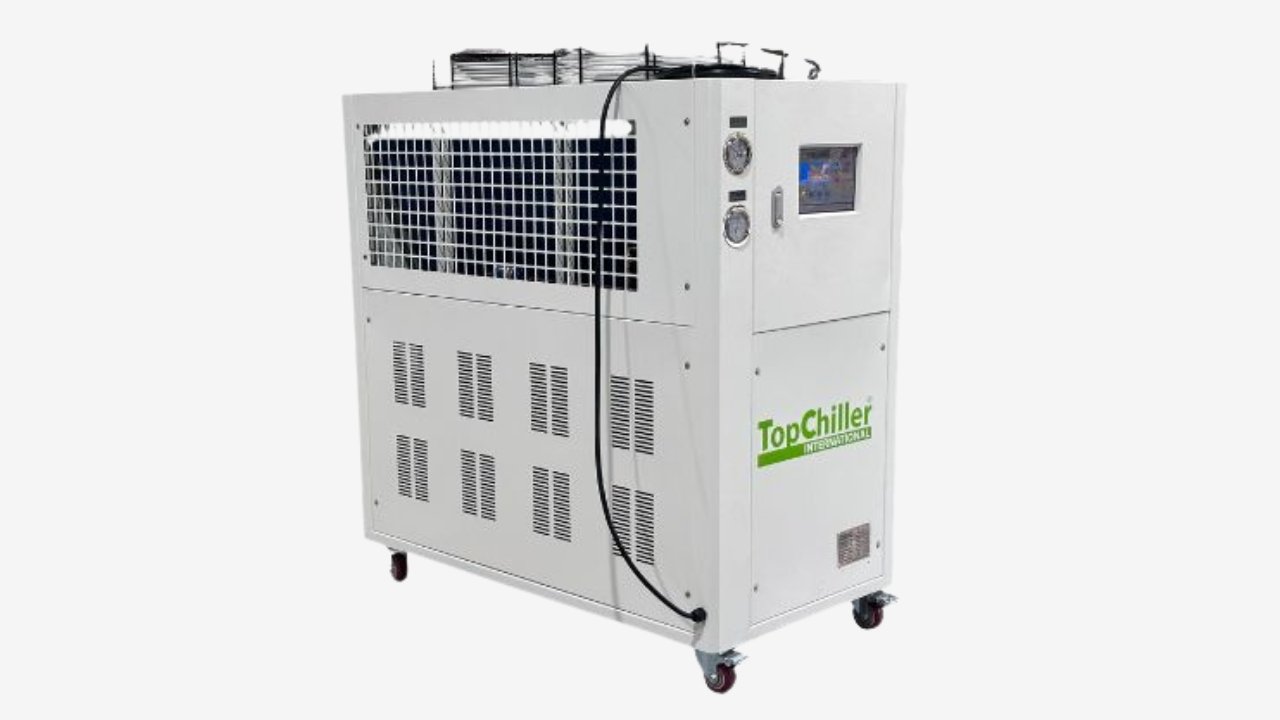
Understanding the difference between cooling capacity and cooling power is essential for selecting a chiller that meets your application. Whether you need a compact chiller for space-limited applications or a high-capacity system for demanding laser processes, we provide expert consultation and customized solutions.
ChillerOne’s product range includes air-cooled chillers and water-cooled chillers with diverse technologies – Get custom chiller quote now.


 English
 Spanish
 Arabic
 Vietnamese

