


International Brands We Collaborate With


Features of ChillerOne Extrusion Chiller
- Providing efficient cooling power for all the extrusion processes and machines
- The precise temperature control is ±0.5°C, ensuring stable temperatures for the extrusion molds and the shaping devices.
- It adopts a durable scroll or screw compressor that can operate for a long time with low maintenance costs.
- Free cooling method is also available during the wintertime.
- Full process technical support is provided, from selection calculation to installation and commissioning.
ChillerOne — your professional extrusion chiller supplier
Extrusion Chiller is an indispensable core process in the plastic extrusion production line. Precisely controlling the temperature of the molds and shaping devices directly contributes to improving product size accuracy, surface quality, and production consistency. Its efficient cooling capacity helps shorten the molding time and tap into production capacity potential. At the same time, steady operation and intelligent control can protect the molds, save energy, and optimize the production cost.
As a professional supplier of temperature control solutions for extrusion processes, ChillerOne offers different types of units and complete system integration products. If you need any assistance, please feel free to contact us at any time.
The Types of Chillers Applied in Plastic Extrusion

The air-cooled chiller uses an internal fan to force the surrounding air through the finned tube condenser, then removes the heat from the refrigerant. This system has a high degree of integration and does not require an external cooling tower or a circulating water system, simplifying the installation process and making it applicable for sites with limited water resources or where it is inconvenient to install a cooling tower. The refrigeration efficiency is affected by the ambient dry-bulb temperature. In hot summer days or when the workshop ventilation is poor, the condensation pressure may increase, which may lead to a decrease in the energy efficiency ratio. In plastic extrusion, it is usually used for small and medium-sized extruders, auxiliary cooling systems, or cooling situations with intermittent production cycles.

The water-cooled chiller uses the circulating water provided by the external cooling tower to cool the refrigerant in the shell-and-tube or plate condensers. Due to the higher specific heat capacity of water compared to air, this type of unit usually keeps a lower condensation temperature and a higher energy efficiency ratio. However, it needs a cooling water system, along with water treatment, pipeline laying, and regular maintenance. On large, continuously operating plastic extrusion lines, like high-speed production of thick-walled pipes and plates, the water-cooled chiller can provide continuous and powerful cooling capacity, guaranteeing constant process temperatures.
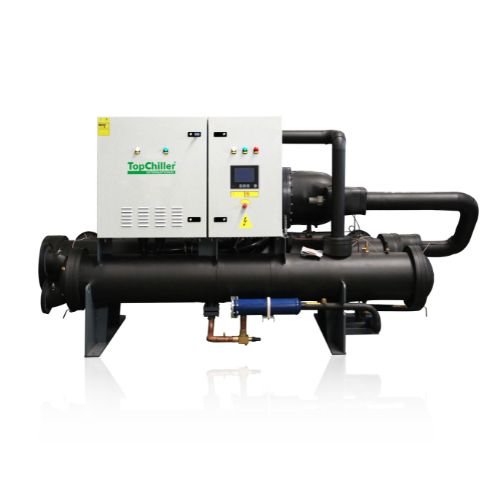
The chiller equipped with a vortex compressor uses the meshing of the moving and stationary vortex discs to form a continuously changing compression chamber to complete the inhalation, compression, and discharge of gas. This structure has many excellent properties, such as low vibration during operation, low noise, and high volumetric efficiency. For most conventional plastic extrusion applications, such as the production of packaging films and ordinary profiles, the refrigeration range and adjustment performance it provides can well match the requirements, achieving a balance between energy efficiency and reliability.

The chiller using a screw compressor relies on the rotational meshing of the male and female rotor teeth to perform compression. This model has a sturdy structure, a wide allowable pressure ratio range, and is suitable for operating under high-pressure differential conditions, and can gain stepless regulation of refrigeration capacity through a slide valve mechanism. The single-unit head refrigeration capacity is usually large, suitable for providing cooling sources for large-diameter extruders or processes that require cooling the material to low temperatures. In large centralized cooling systems or high-intensity continuous extrusion production, screw-type chillers have excellent durability and load adaptability.
Reliable Certification
Authoritatively certified, our extrusion chiller complies with international regulations and keeps ideal working conditions for extrusion workshops.


Application in the Plastic Extrusion

In injection molding, molten plastic is injected into the mold. The water chiller provides rapid cooling for the mold. This shortens the time required for the plastic to solidify and for the product to be ejected, helping you accelerate the production pace. At the same time, uniform cooling effectively reduces the deformation and internal stress of the product caused by uneven shrinkage.

In the extrusion process, plastic is continuously pushed through the die to form long products such as tubes and plates. The water cooler is mainly responsible for cooling the barrel of the extruder, the mold, and the following shaping device. Steady temperature control guarantees that the shape and size of the extruded products remain consistent, which is crucial for keeping product accuracy and increasing production line speed.

In thermal forming, the softened plastic sheet is adhered or pressed onto the mold to be shaped. A water chiller cools the mold during this process, causing the plastic sheet closely attached to the mold to rapidly solidify and take shape. This helps you obtain products with clear contours and prevents the products from deforming due to residual heat after demolding.
See the Extrusion Chiller in Action
Watch how the extrusion chiller delivers stable temperature control, fast cooling response, and reliable performance in real industrial working conditions.
Why does Plastic Extrusion Need Chillers?
In the plastic extrusion process, a chiller is an indispensable key piece of equipment. It addresses the core challenges in your production through precise thermal management. It systematically removes the excess heat from the process, transforming the thermal processing into a stable and controllable manufacturing process.
Plastic extrusion relies on high-temperature melting of raw materials, but excessive heat, if not controlled, will directly influence the quality of your products and the stability of production. The chiller first provides cooling for the extruder barrel, precisely keeping the temperature of the plastic melt within the range most conducive to processing. This is the first step in controlling the basic performance of the product.
Your production equipment itself also needs protection. For instance, the hydraulic system of the extruder produces a lot of waste heat during continuous operation. The chiller can absorb this heat with high efficiency, keeping the temperature of hydraulic oil in a safe range, prolonging the equipment’s service life, and lowering downtime due to malfunctions.
After the melt is formed through the mold, it needs to immediately transition from a high-elastic state to the solid state. At this point, you need a powerful and controllable cooling stage. The chiller provides a stable, low-temperature water source for cooling rollers or water baths, enabling the product profile to solidify quickly and be precisely shaped and sized to the desired form and dimensions.
For profiles with complex cross-sections, the uniformity of cooling determines the straightness of the final product. Uneven cooling can cause internal thermal stress, leading to warping. The constant cooling conditions provided by the chiller can unevenly eliminate the temperature differences among various parts of the profile, guaranteeing their steady dimensions and a more complete appearance.
Key Cooling Points in Plastic Extrusion
Quenching: Initial Rapid Setting
When molten plastic at a temperature above 200°C is extruded from the mold, it needs to be immediately cooled on its surface with water or air to guarantee rapid curing and shaping. It is important to control the cooling rates of the inner and outer layers; excessive temperature differences may cause stress within the product.
Air Cooling: Buffering and Transition
Between the two water cooling processes, or when dealing with specific workpiece shapes, you can use controlled air for cooling. By adjusting the temperature and flow rate of the air, you can allow the material temperature to drop gradually. This can prevent the shock caused by sudden cooling. This method is often applied for thick-walled or complex cross-sectional workpiece shapes.
Final Cooling: Achieving Thermal Equilibrium
Before performing cutting or winding, you need to cool the product to room temperature completely. This can be accomplished through additional air cooling or a warm water bath to reach full thermal equilibrium. This step eliminates the remaining heat and prevents the following products from deforming. At this stage, it is suggested to monitor both the temperature and size simultaneously.
Advanced Cooling Techniques: Meeting Special Requirements
For higher production demands, temperature-controlled cold rollers can be used, which can improve the surface finish of the product while cooling. In high-speed or thin-walled extrusion, vacuum cooling can speed up the cooling rate. In special applications, liquid nitrogen can be used for low-temperature cooling to lock in material properties.
Advantages of Chillers for Plastic Extrusion
Improve product quality and consistency
The water chiller provides rapid and uniform cooling for molds and forming devices. This leads to optimized product size accuracy, better surface finish, and more stable mechanical performance. At the same time, deformation problems caused by shrinkage or uneven internal stress during the production process are controlled, greatly lowering the scrap rate and guaranteeing that the quality of each batch of products has a high degree of repeatability.
Optimize production efficiency and economic output
Fast cooling directly shortens the molding time of plastics and accelerates the traction speed of your production line, and shortens the cycle time. Within the same period of time, you can gain a higher effective output, increase production capacity utilization.
Protect core production assets
The stable cooling process reduces the thermal shock that molds experience due to drastic temperature fluctuations. This greatly slows down the thermal fatigue and wear process of mold materials, prolonging their service life. For you, it saves considerable costs for mold maintenance and replacement.
Reduce ongoing energy costs
Modern water chillers use efficient compressors and intelligent control systems. They can dynamically adjust the cooling output according to the actual load of the extrusion production line, keeping high energy efficiency even under partial loads. This converts energy efficiency into quantifiable advantages in single-piece production costs, reducing the power consumption of equipment during long-term operation and lowering your single-piece production costs.
Strengthen process control and intelligent operation
The integrated control system supports synchronized and high-precision temperature management of all cooling units along the production line. Once the process parameters are set, they can be precisely replicated in all subsequent productions. The advanced network interface enables you to remotely monitor all operating parameters and manage production status in advance.
OK. Its wide temperature control range (down to -25°C) and stable flow rate are especially designed for uniform cooling of complex cross-sections, which is crucial for keeping the dimensional stability of profile materials.
The unit integrates natural cooling functionality. When the ambient temperature is low enough, the compressor can be shut down, and only the fan can operate to meet the cooling requirements, directly lowering your operating energy consumption.
With high-efficiency and durable scroll compressors and all stainless steel heat exchange piping as core components, it is specifically designed for long-term continuous operation of the extrusion line to ensure the stability and uninterrupted production.
By providing precise water temperature control of ±0.5°C, it helps you evenly cool complex profiles, significantly reducing internal stress, warping, or surface defects caused by temperature differences.
It systematically removes excess heat generated by the plastic throughout the process, from melting, forming, to curing, guaranteeing stable melt temperature, protecting equipment, and controlling the final size and shape of the product.


 English
 Spanish
 Arabic
 Vietnamese

