


International Brands We Collaborate With


What is a shell and tube heat exchanger
The shell and tube heat exchanger is the key equipment for the chiller to achieve the refrigeration cycle. A simple structure can play a huge role in your factory. If you want to understand the compatibility of the chiller in your factory, the heat exchanger is a good entry point.
The shell and tube heat exchanger consists of a sturdy cylindrical metal shell and hundreds of thin tubes neatly arranged inside the shell. These pipes are precisely calculated in terms of Angle and spacing, thus forming a stable heat exchange network. Both ends of the shell are equipped with end covers, and the interior is clearly divided into flow channel Spaces, allowing two different fluids to follow their own paths.
When you turn on the switch of the chiller, one side of the fluid will flow inside the pipe, while the other fluid will flow outside the pipe.This heat conduction method that directly contacts the pipe wall makes the energy transfer of the chiller both direct and efficient.
Reliable Certification


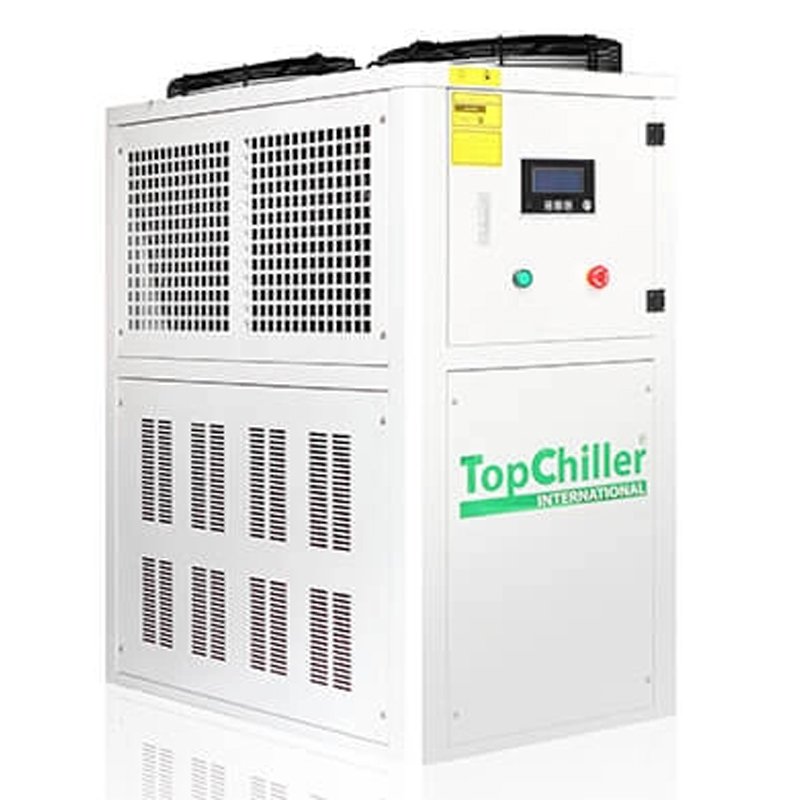
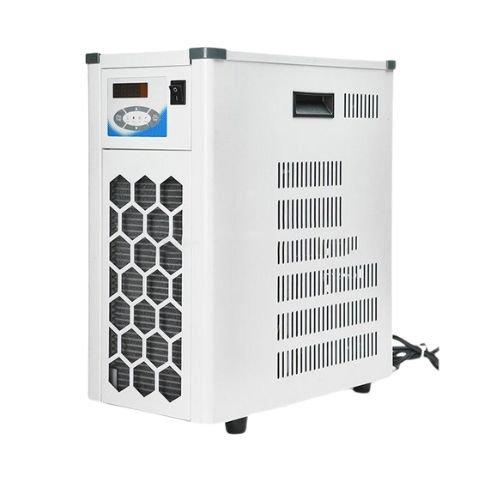

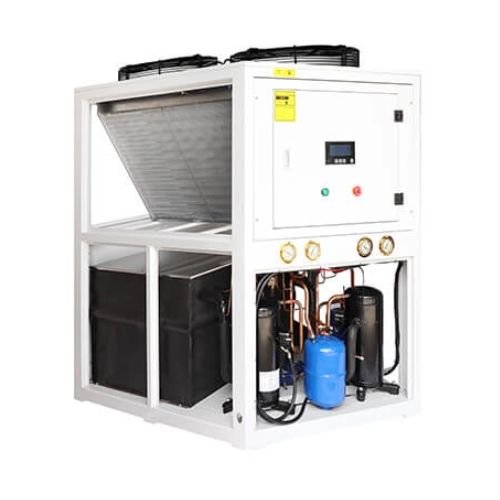
See the Shell and Tube heat exchanger Chiller in Action
Watch how the shell and tube heat exchanger chiller delivers stable temperature control, fast cooling response, and reliable performance in real industrial working conditions.
Shell and tube heat exchanger working principle
In the chiller, the shell and tube heat exchanger completes heat exchange in four steps, enabling the refrigerant and water to efficiently transfer energy without mixing the two:
Fluid introduction
When you start up the machine, the chiller sends two fluids into the heat exchanger. One goes through the tube side (inside the thin copper tube), and the other goes through the shell side (in the cylindrical shell space outside the tube).
Circulation inside the pipe
When designing a chiller system, we make the tube-side fluid (such as cooling water) flow along a thin tube, and along the way, it is guided by the baffle (baffle plate) in the shell side, turning around the tube bundle. Usually, it circulates four times inside the tube. Enter from the entrance and walk straight along the tube bundle for a while first.
When encountering a barrier, turn to the other side and walk the second section. To ensure more thorough heat exchange, this process will be repeated four times. Each turn increases the contact time with the pipe wall, which enables the heat of the chiller we designed to transfer more thoroughly.
Heat transfer through the pipe wall
In the shell and tube heat exchanger, the high-temperature fluid (such as refrigerant vapor) flows along the outer wall of the tube bundle. Through indirect contact with the pipe wall, the high-temperature fluid will transfer heat to the low-temperature one.
Fluid discharge
After four cycles, the tube-side fluid (cooling water) is discharged with the absorbed heat and released in the cooling tower of the chiller. The next time you turn on the chiller, a new batch of fluid will come in. Repeat these four steps.
The types of tube and shell heat exchanger
The type selection of shell and tube heat exchangers will affect the efficiency and stability of the chiller system you choose. According to the differences in the flow patterns of the two fluids and the variations in their subtle structures, it can be divided into: flow types (co-current, counter-current, cross-flow) and floating head structure subdivisions (M-shaped fixed tube sheet, U-shaped tube, S-shaped floating head).
Classify by flow type
Co-current heat exchanger
It is often used in low-temperature difference scenarios, such as the initial heat exchange between cooling water and low-temperature refrigerants. The thermal efficiency is relatively low. If you have the idea of purchasing it, you can use it as an auxiliary.
Counter-flow heat exchanger-Highest thermal efficiency
For instance, in a condenser, high-temperature refrigerant vapor condenses in the shell side, while cooling water flows in the opposite direction in the tube side to absorb heat.
Counter-flow heat exchanger can also be combined with the S-shaped flow channel design to enhance turbulence and reduce the risk of scaling, making it suitable for high-load chillers.
Cross-flow heat exchanger
Two fluids flow perpendicularly at 90 degrees. For instance, the shell-side fluid passes laterally through the tube bundle, while the tube-side fluid flows longitudinally.
Cross-flow heat exchangers are mostly used in evaporators or in special working conditions. For instance, when the refrigerant needs to undergo a phase change (from liquid to gas), the cross-flow can balance the pressure drop and heat exchange efficiency. However, due to their complex structure, they are less frequently adopted in chillers.
Subdivide according to the floating head structure
U-tube heat exchanger
U-tube heat exchangers are suitable for scenarios where the temperature difference between the tube side and the shell side is large, such as preheaters in seawater desalination systems. U-shaped tubes can be freely extended and contracted to reduce thermal stress, but cleaning the tube side is difficult.
S-type floating head heat exchanger
Relatively flexible. This is the top choice for our high-load chiller models. For instance, in the condenser of a large centrifugal chiller, the S-shaped floating head design allows the tube bundle to expand freely with temperature changes, thus avoiding leakage.
The floating head end is detachable, making it convenient for you to clean the scaled tube side.
If the quality of the cooling water in your factory is poor, such as industrial circulating water, choose the S-type floating head type. If you want to choose a household chiller with stable water quality, the M-type fixed tube sheet is more economical.
Suppose you are dealing with high-temperature difference scenarios, such as the condensing temperature of an ammonia refrigeration system. The floating head type must be adopted. Avoid cracking of the tube sheet.
If you are dealing with high-temperature difference scenarios, such as the condensing temperature of an ammonia refrigeration system. The floating head type must be adopted. It can avoid cracking of the tube sheet.
The advantages of shell and tube heat exchangers
The advantages of shell and tube heat exchangers can really help you save a lot of trouble when choosing a chiller. Let me tell you a few benefits based on their actual uses:
Low cost
For chillers with the same cooling capacity, using the shell and tube type can save a considerable amount of equipment costs.
Large heat capacity
If you encounter high-temperature working conditions (such as ammonia refrigeration systems), its high-temperature resistance performance is more reliable than that of other models.
Customizable shell and tube heat exchangers
If you make a small chiller, we will shrink the tube bundle to reduce the volume. To build a large cooling capacity unit, we will increase the number of tube bundles to improve efficiency. It is tailor-made exactly to your needs, unlike fixed models, which are so rigid.
Stable under pressure
When you use it in an industrial chiller, even if the system pressure fluctuates occasionally, hell and tube heat exchanger will not leak. It’s more secure for you
Save electricity
The shell and tube heat exchanger keeps the pressure loss within a reasonable range by optimizing the flow channel design. The pump of your chiller won’t have to exert extra effort to push the fluid. The downstream flow rate is stable, energy consumption naturally decreases, and it also avoids problems caused by pipeline pressure build-up.
Thermal expansion and contraction
The tube bundle can expand and contract freely and will not crack like a fixed structure, thus having a longer service life.
It can handle special fluids
Shell and tube heat exchangers have good compatibility with flammable (such as propane) and toxic (such as certain chemical media) fluids. It is very suitable for you to use as a water chiller for the chemical industry. It can isolate dangerous fluids, making the system safer.
Simple maintenance
The shell and tube structure has fewer twists and turns. When your cooling water contains impurities, regularly draw it out to remove the scale. It can be done within half an hour.
Long-term stable operation
The pipe shell is made of thick-walled steel pipe or stainless steel, which is resistant to corrosion and erosion. ChillerOne shell and tube heat exchangers are more durable and offer better value for money in the long run
Compatible with multiple refrigerants
Ammonia, Freon (R134a/R410A), carbon dioxide, and other shell and tube heat exchangers can all be used. Even if you want to change the refrigerant and upgrade the system in the future, there is no need to replace the heat exchanger.
The important role of shell and tube heat exchangers in chillers
High thermal efficiency
Multi-channel tubes and baffles, in combination with baffles in the shell side.
- Turbulence intensification: The surface of the pipe wall is processed into a threaded or corrugated shape to disrupt the laminar flow state of the fluid and enhance the degree of turbulence.
Reduce scaling
During the long-term operation of the chiller, scale will reduce the heat exchange efficiency. And shell and tube heat exchangers have :
- High flow rate design: The water flow rate on the tube side is high, which flushes the tube wall and inhibits the adhesion of scale.
- Easy-to-clean structure: The tube sheet and the shell are connected by flanges, allowing for quick disassembly and cleaning.
- Optimization of pipe spacing: By reducing the pipe spacing, the heat exchange area is increased within a limited space, while the space for scaling is also decreased.
Mechanical integrity
Manufacturing processes in line with international standards
The shell and tube sheet are made of forged steel or stainless steel, and the welding process is approved by the American Society of Mechanical Engineers (ASME).
The connection between the tube sheet and the heat exchange tubes adopts a dual process of expansion joint and sealing welding. An expansion joint ensures sealing performance, while welding enhances mechanical strength.
Seismic and fatigue-resistant design
Expansion joint configuration: The shell is equipped with corrugated expansion joints to compensate for the expansion and contraction differences caused by temperature differences between the tube bundle and the shell.
Support structure optimization: Support plates are set on the shell side to prevent the vibration fatigue fracture of the tube bundle.
Operational safety
Dual protection against pressure and temperature
A spring-loaded safety valve is installed on the shell side, which automatically releases when overpressure occurs.
When the shell-side temperature exceeds the set value, the PLC automatically cuts off the heat source and starts the backup cooling system. Save your manual time.
Leak-proof and pollution-proof design
- Double sealing structure: The flange adopts a double seal of metal metal-wound gasket and a graphite gasket.
- Isolation: Even if there is a slight leakage on the pipe wall, the leaked medium will enter the shell-side buffer zone and will not contaminate the process fluid.
At present, our water chillers have integrated artificial intelligence technology, which can operate automatically and support remote program Settings on mobile phones and computers. Meanwhile, considering that our friends come from all over the world, the chiller can be customized in three national languages to provide convenience for everyone. Our production philosophy has always prioritized altruism. Fan Qun is very much looking forward to more product inquiries from friends across the ocean.
Plate heat exchanger vs shell and tube
What exactly are the differences between these two? Which one is suitable for your industry? Don’t worry. Next, I’ll make it clear to you.
Shell and tube heat exchanger
Advantages
High-pressure resistance and high-temperature resistance
- Not picky about work: The tube side and shell side can handle all kinds of dirt, such as sand and metal shavings in the cooling water, and they are not afraid of clogging.
- High heat exchange capacity: Suitable for high-power water chillers (such as those used in factory cooling towers).
Limitation
- It covers a large area.: It’s heavy and big, and not suitable for small factories.
- Cleaning is troublesome: The tube bundle is welded inside the shell. If you want to clean it, you have to disassemble the end cover, which is time-consuming and laborious.
- Average efficiency: The fluid flows inside the tube, and the heat transfer coefficient is lower than that of the plate type, which may result in higher power consumption.
Suitable for your situation
- The quality of the cooling water is poor (containing a lot of impurities)
- It requires long-term stable operation and has a low maintenance frequency.
Plate heat exchanger
Advantages
- High efficiency and energy saving: The heat transfer coefficient is higher than that of the shell and tube type, which can save you a large amount of electricity bill.
- Easy to clean: It can even be pressurized for flushing, making it suitable for places with high hygiene requirements like food factories.
- Flexible adjustment: Just add a few plates. The cost of upgrading and transformation is low.
Limitation
- Poor durability: It has low pressure resistance and is prone to leakage when the temperature exceeds 250℃. Use with caution in steam systems.
- Difficult sealing: Rubber gaskets have a limited lifespan and are prone to leakage after long-term use, so they need to be replaced regularly.
Suitable for your situation
- The cooling water is clean (such as purified water or softened water).
- The factory space is small, or the configuration needs to be adjusted frequently.
For example:
If you are in the food processing business, the chiller needs to handle milk or juice. The cooling water must be clean. Select a plate heat exchanger that is convenient.
If you are in a chemical plant, the refrigerant is under high temperature and high pressure. Choose a shell and tube heat exchanger.
ChillerOne is a professional supplier of water chillers. Presently, our water chillers have integrated artificial intelligence technology, which can operate automatically and support remote program Settings on mobile phones and computers. Meanwhile, considering that our friends come from all over the world, the chiller can be customized in three national languages to provide convenience for everyone. Our production philosophy has always prioritized altruism. Fan Qun is very much looking forward to more product inquiries from friends across the ocean.
Yes, but it depends on the situation. If only the heat exchanger is clogged or leaking while other components are normal, they can be replaced separately. Remember that the model matches. If the refrigerant is contaminated or the compressor is aged, replacing it alone won’t work.
When selecting shell and tube heat exchangers, we evaluate the thermal design, pressure and temperature ratings, material compatibility, maintenance requirements, and whether they comply with industry standards for chiller processes and regional regulatory requirements.
It depends on a careful consideration of water quality, maintenance, and operation intensity. Hard water can last for 3 to 4 years, while soft water or water with additional treatment equipment can last for over 5 years.
If your industrial water is hard, a softening device can be added. Clean the tube bundles 1-2 times a year to prevent scaling and flow blockage. A more specific maintenance manual will be provided to you for free after you purchase the ChillerOne.
The tube side is descaled by circulating a weak acid/alkali solution, and the shell side is flushed away with a high-pressure water gun to remove debris. Do it 1-2 times a year. If the water quality is hard, do it more frequently. The soft water system can reduce scale. For complex scaling, find a professional. Don’t pry it off hard.


 English
 Spanish
 Arabic
 Vietnamese

