

Marcas internacionales con las que colaboramos


Two-unit” System for Efficient Cooling
- Cooling range from -30°F to 130°F
- Designed for both indoor and outdoor
- Cooling capacity: 10 tons to 85 tons
- Intelligent microprocessors to control chiller operations
- Eco-friendly R-454B refrigerant
Your Trusted Split System Chiller Manufacturer and Supplier in China
ChillerOne split system chillers are robust cooling systems designed to have two main components, where you install one indoors and the other outdoors.
We recommend these chiller units in situations where your setup cannot allow for packaged air-cooled chillers or packaged water-cooled chillers.
The first component is the air-cooled condenser unit, which should be located outdoors, thereby rejecting heat to the atmosphere. Then you place the second component, which is the evaporator and compressor indoors.
By separating the two components of split system chillers, you will achieve higher energy efficiency. Furthermore, when you integrate it with the modern inverter-driven compressors, you can regulate speed and reduce power consumption by over 25%.
Additionally, this separation guarantees quiet indoor operation, which also protects the components stored indoors for chiller longevity.
So if you are looking for a flexible cooling unit, then split system chillers offer a practical solution – contact us for free chiller sizing analysis.
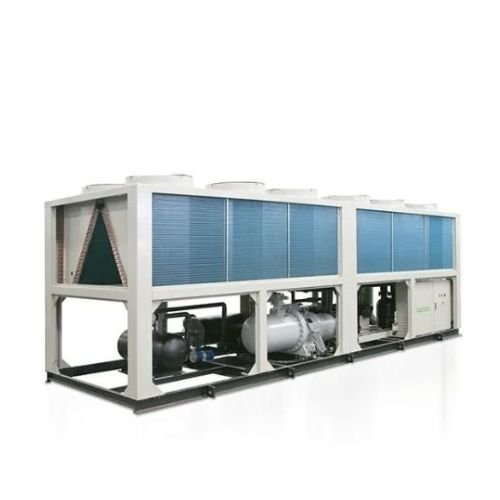
High productivity air cooled split water chiller with semi-hermetic screw compressor type and a shell and tube evaporator.

Ceiling mounted air handling unit high air speed and high air capacity split air chiller cooling system with a centrifugal fan type.
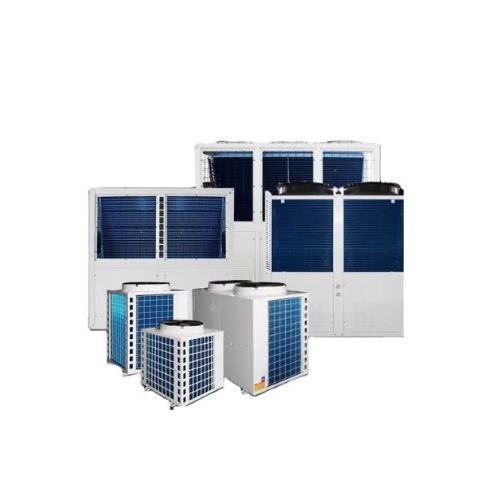
Remote control air cooled water chiller with semi-hermetic screw compressor type with 280KW~1120KW cooling capacity.

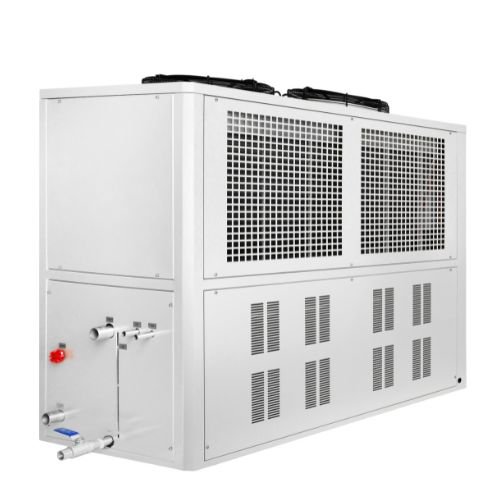
Axial motor fan type split cooling system with copper pipe tube type with durable and long lasting qualities.
Certificación confiable




See the Split System Chillers in Action
Watch how the split system chillers delivers stable temperature control, fast cooling response, and reliable performance in real industrial working conditions.
What is Split System Chiller
Chillerone’s split system chiller is a type of industrial or commercial cooling device that typically separates the key components of the refrigeration system. Unlike a packaged chiller, it sets the evaporator and water system components indoors, while installing heat-dissipating components outdoors. The two sections can be connected by a refrigerant piping to form the complete cooling system. The special structure design of split system chillers not only optimize space layout, but also improve thermal dissipation and noise issues.
Working Principle of Split System Chiller
Although the structure of a split system chiller is different from other types of chiller, its core working principle still relies on the standard vapor compression refrigeration cycle. It contains four core processes, the following are detail introductions:
- Compression: Refrigerant gas with low temperature and low pressure evaporated from the previous cycle is drawn by a compressor. The compressor then performs adiabatic compression on the refrigerant gas, compressing it into superheated gas with high temperature and high pressure. This process occurs in the outdoor unit of the split system chiller.
- Condensation: The high-temperature refrigerant then enters the condenser. Through a fan or a water-cooled condenser, the refrigerant can release heats into the outdoor environment. As temperature decreases, the phase change occurs, which can condensate the gas into liquid refrigerant with medium temperature and high pressure.
- Expansion: The liquid refrigerant achieves throttling through the expansion valve or capillary tube. This step is an adiabatic expansion process that occurs in indoor units, which makes the pressure and temperature of refrigerant drop sharply. Then the refrigerant can be formed into a mixture of gas and liquid with low temperature and low pressure.
- Evaporation: The evaporation process also occurs in the indoor unit of the split system chiller. The gas-liquid mixture enters the evaporator and absorbs heat from the chilled water, completely evaporating into gaseous refrigerant. While the temperature of the chilled water is also decreased to achieve the cooling objective. The cooled chilled water can be conveyed to terminal units for use, and then enters the next cycle.
Key Components of Split System Chiller
A standard split system chiller typically consists of the indoor unit, outdoor unit, and refrigerant piping system to achieve cooling performance. Learning its core components can help you make a better purchase decision to ensure the machine can meet actual requirements.
Indoor Unit
The indoor unit of a split system chiller is the core component to generate and deliver cooling capacity. It is mainly used to cool processed water or the circulating water within air conditioning systems. Indoor units are generally installed in machine rooms, production workshops, or near equipment, including the following components:
- Evaporator: The evaporator is a core component to achieve refrigerant heat exchange. The refrigerant can be evaporated within the component to decrease the temperature of water. Common types of evaporator include shell-and-tube evaporators and plate heat exchangers. You can choose the suitable one based on actual cooling capacity requirements, water quality conditions, and maintenance demands.
- Expansion Valve: As a throttling device of the split system chiller, the expansion valve is used to decrease the pressure of liquid refrigerant from the condenser. It transforms the liquid refrigerant into a mixture of gas and liquid. A thermal expansion valve or a more precise electronic expansion valve are two commonly used types.
- Water Pump and Tank: The bomba de agua is responsible for delivering the chilled water to achieve a circulation between the evaporator and external cooling equipment. The split system chiller also supports being equipped with a buffer tank to store chilled water, ensuring stable system pressure and water capacity.
- Control System: The control system is mainly used to monitor the water temperature, pressure, capacity, and operation conditions. You can set key parameters by the control panel based on actual demands. It also supports automatic start/stop functions, fault alarms, and remote communication, ensuring the reliability of operation.
Outdoor Unit
Main power and heat-generating components of the split system chiller are installed on rooftops, outdoor platforms, or well-ventilated areas to form the outdoor unit. This unit is typically used to achieve thermal dissipation and energy release, the following are core components:
- Compressor: A compressor is one of the most important components of the cooling system, and can be divided into compresor scroll y compresor de tornillo to meet different demands. For systems with small to medium cooling capacity, the scroll compressor is suitable, which features tight structure and is easy to maintain. While the screw compressor is typically used to handle medium-to-large cooling capacity, ensuring higher stability.
- Condenser: The split system chiller is also equipped with an air-cooled condenser without relying on a torre de refrigeración or any cooling water systems. Through a fan, the heat of refrigerant can be directly discharged into outdoor environments, reducing system complexity and water consumption.
- Heat Dissipation System: Proper fans can significantly improve the heat dissipation performance of the split system chiller. The chiller typically employs an axial flow fan to offer forced convection airflow for the air-cooled condensers, accelerating the thermal dissipation process. If your project is sensitive to noise level, a fan with large diameter and low speed will be suitable.
Refrigerant Piping
The refrigerant piping connecting the indoor unit and outdoor unit is one of the key systems that distinguishes split system chillers from integrated chillers. When selecting the split system chiller machine, you should pay attention to the length and height of the refrigerant piping. Ensure that the key parameters of the piping are limited within proper range, thereby improving cooling efficiency and system stability.
Advantages of Split System Chiller
Instalación flexible
One of the most significant advantages of the split system chiller is its flexible installation and layout. By isolating the core components, you can freely plan the equipment locations based on actual site conditions. The split system chiller is especially suitable for facilities with limited machine room space, inadequate ventilation workshops, and other similar applications. Compared to integrated chillers, this type of chiller does not require a centralized installation space, which can reduce chiller installation cost for your project.
Low Noise and Heat Load
The split system chiller set main noise components such as compressor and fans into outdoor space, significantly reducing the noise level during the operation process. This is an important feature for many industrial or commercial applications that are sensitive to noise. The isolation design of this chiller also decreases the heat accumulation within the indoor environment, improving the air quality. Due to its low noise level and heat load, the split system chiller is suitable to meet high demands of various industries.
High Stability
Outdoor units of the split system chiller can be installed in the space with good ventilation to achieve high condensing efficiency. It ensures stable operation of the chiller within the working condition with high temperature and high load. The split system chiller offers good heat dissipation performance to adapt to high temperature environments, while also ensuring stability of continuous operation. Its high stability not only decreases the failure rate, but also reduces production loss caused by downtime.
Operación continua
The split system chiller also supports continuous operation, which is suitable for industrial applications to achieve mass production. Its isolated structure is helpful to improve durability and reliability of the system, reducing downtime risks. The chiller offers excellent outdoor thermal dissipation to reduce the risk of compressors within long term and high load of operation. It is also equipped with a stable temperature control system, reducing harmful effects to the equipment caused by frequent start-stop cycles.
Fácil de mantener
The isolated structure of the split system chiller makes it more easy to achieve targeted maintenance, reducing operational complexity. Once any component fails or is damaged, you can quickly determine the location of the failure, improving fault diagnosis and repair efficiency. In addition, you can also complete maintenance works on different components separately, which can reduce the overall operational cost.
Applications of Split System Chillers
Due to its unique advantages, the split system chiller is widely used for multiple industrial and commercial applications. It is especially suitable for projects with limited space and complex operation conditions. The following are typical applications of this type of chiller:
- Industrial Manufacturing: The split system chiller used for industrial manufacturing is typically responsible for providing stable process cooling water for key production devices. Such as the extrusion process, CNC machining center, laser cutting, and more. Its main heat source can be installed in outdoor space to prevent additional heat load for workshops, improving stability of the production process.
- Commercial Applications: Commercial applications such as hotels, office buildings, commercial complexes, and other public buildings, generally demand low noise levels. The split system chiller can isolate the components that are prone to generate noise into outdoor space, significantly decreasing noise levels. In addition, the isolated structure also reduces layout space of the chiller, enabling efficient cooling within limited space.
- Data Center: For data centers or precision equipment, this type of chiller offers a highly stable cooling process to ensure the reliable operation of these equipment. It can be also used to integrate with precision air conditioning systems, achieving high-efficiency cooling. If your project also involves high precision demands, the split system chiller is a good solution that balances reliability and cost-effectiveness.
- Medical Industry: The split system chiller is also widely used in the medical industry to meet both low noise and high reliability demands. It can transport noise and heat into the outdoor environment, maintaining a quiet, temperature-controlled work environment. Common applications of this chiller within the medical industry include medical imaging equipment cooling, laboratory instruments, and biopharmaceutical.
The maximum length of refrigerant piping is different within different brands and models. Too long piping may increase the refrigerant pressure loss, thereby reducing the cooling efficiency. It is also possible to damage the compressor due to difficult oil return. In addition, excessively long refrigerant piping means higher refrigerant charge requirements, which can increase the entire cost.
No. The split system chiller is only used for cooling. If you require cooling processes or need to prevent freezing of circulating fluids within the low-temperature environment, models equipped with low-temperature options are suitable. While for applications requiring both cooling and heating, a heat pump split chiller may be useful to achieve the two modes.
Proper maintenance will extend the service life of your chillers, while also ensuring maximum functions and efficiency. In general, the air filter and noise level should be inspected every month. You should also clean outdoor unit condenser fins and check refrigerant pressure for quarterly. We also recommend that every year complete a comprehensive inspection, including compressor lubricant, refrigerant charge, and performance testing.


 Spanish
 English
 Arabic
 Vietnamese

