

International Brands We Collaborate With


Features of Hydroponic Chillers
- Precise temperature control within 18 to 21°C (65 – 70°F).
- Automate control without the need for manual checks.
- Well-adapted to various irrigation methods.
- Create an environment that is conducive to maintaining the plants’ resistance while being unfavorable for the invasion and spread of pathogens.
- Increase dissolved oxygen, promoting vigorous growth.
ChillerOne—Provide the Best Hydroponics Water Chiller for You
Stable root zone temperature is the core for the health and high yield of plants. ChillerOne is a professional hydroponics water chiller manufacturer. Our water chiller employs an efficient and reliable compression refrigeration technology, which can precisely maintain the temperature of your nutrient solution within the ideal golden range of 18-22°C. We apply an intuitive intelligent temperature control system, allowing you to set it with just one click and have complete peace of mind in controlling the temperature. Choose Chillerone, and we will offer our sincere service.
Water Chiller Types for Hydroponics
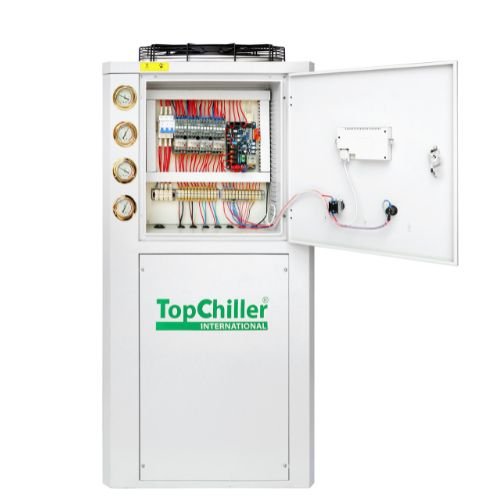
Air-cooled chillers transfer heat directly to the external air through fans and refrigerant coils, cooling the space and making it an independent unit. Air-cooled chillers are suitable for smaller spaces or water-scarce areas.
Compared to water-cooled chillers, they are easier to install and consume less water, making them more popular.
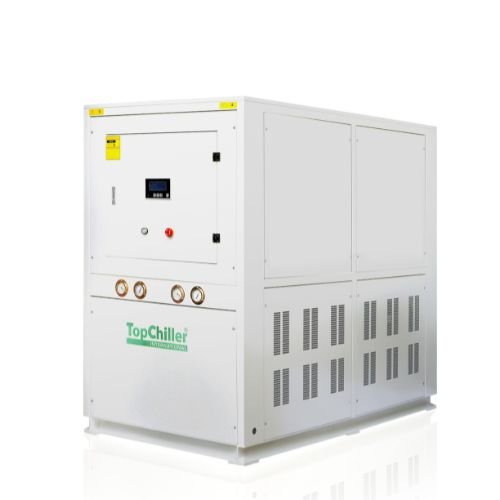
Different from air-cooled chillers, water-cooled chillers use water circulation and cooling towers to remove heat. They cool the water through the refrigerant circulation, and then transfer the cooled water to the air treatment equipment. Afterwards, the water from the cooling tower takes away the heat from the condenser to the atmosphere. Water-cooled chillers are suitable for higher effect demand or larger applications.
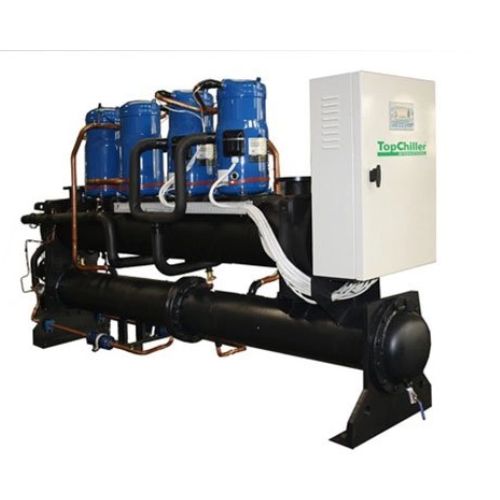
An inline chiller is a compact cooling device. It is directly connected to the main circulation pipeline of the hydroponic system. The nutrient solution is pushed by the water pump, flows through the heat exchanger inside the water cooler, is cooled, and then returns to the planting area, which can provide precise temperature control for water during its flow.
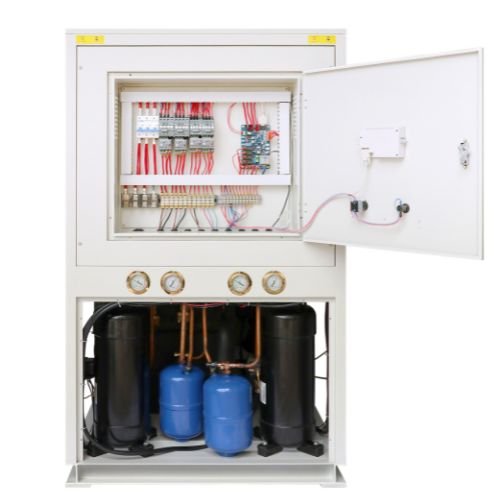
Reservoir chillers, also called closed-circuit, are equipped with a water storage tank that is used to store and continuously circulate the cooling water. Two hoses are connected to the main nutrient solution storage tank to form an independent cooling circulation loop. This ensures stable temperature and prevents sudden temperature changes, suitable for direct and small-scale cooling.
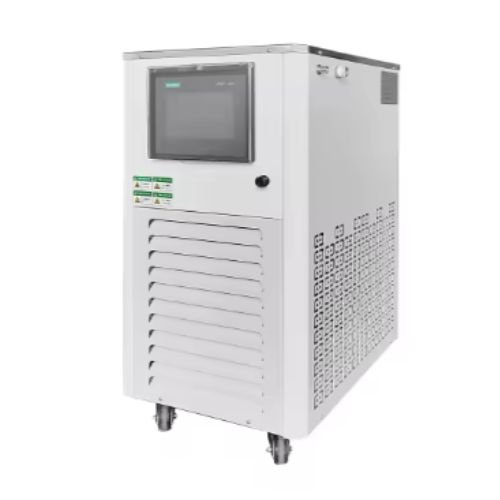
A drop-in chiller is a cooling device that integrates heat exchange tubes, usually made of titanium. It immerses the evaporator coil (or cooling tube) directly into the nutrient solution storage tank. The cooling effect is directly transferred to the liquid, eliminating the need for complex piping systems.
Reliable Certification


Hydroponics Water Chillers Applications
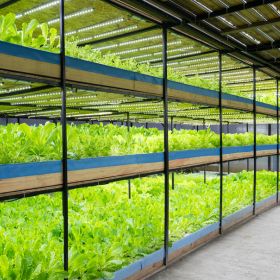
Hydroponics water chillers can precisely maintain the temperature of the nutrient solution within the most suitable range for most crops. In complex smart agriculture systems, the water cooling system automatically adjusts the operation of the water cooler based on real-time collected data, and works in coordination with ventilation, supplementary lighting, and humidification systems to create the best growth environment for plants.
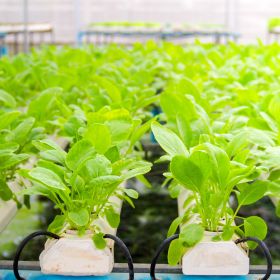
Hydroponics water chillers help reduce energy and labor costs, minimize losses by preventing diseases, increasing the return on investment.
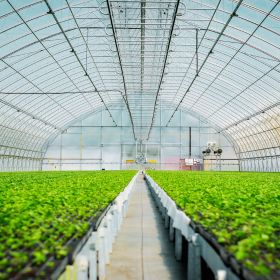
In a greenhouse, the greenhouse effect will cause the temperature of the nutrient solution to be much higher than the ambient temperature, especially during midday in summer. Hydroponics water chillers transform the uncontrollable outdoor climate into a controllable indoor root zone climate.
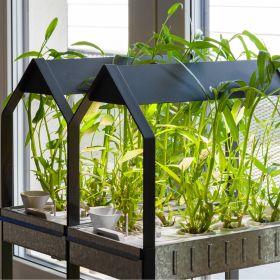
Hydroponics water chillers can work in family hydroponic gardens or an indoor planting cabinet. A hydroponics water chiller can improve clients’ planting success rate and experience, especially for planting high-value crops with temperature sensitivity.
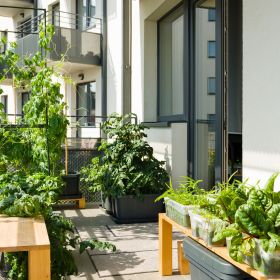
In hydroponic systems for terraces, hydroponic water chillers can help resist the ever-changing outdoor climate and create an independent and stable ideal environment for the plant roots, ensuring the success rate of terrace planting and expanding the possibilities of cultivation.
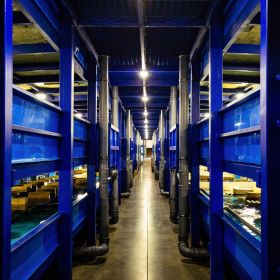
Hydroponics water chillers help create a stable and precisely controllable living and growth environment for aquatic animals throughout the year, which is one of the core environmental control devices for RAS and aquariums to achieve high-density and industrialized aquaculture.
See the Hydroponic Chillers in Action
Watch how the hydroponic chillers delivers stable temperature control, fast cooling response, and reliable performance in real industrial working conditions.
Why Does Hydroponics Need to Apply Water Chillers?
A moderate temperature is of vital importance to the health of the root system. Hydroponics Chillers are devices to control the temperature of the hydroponic water precisely to maintain root health and enhance nutrient absorption rate. It is the most effective solution among other cooling solutions. The temperature is often stabilized within 18 to 21°C (65 – 70°F) by the hydroponics chillers, which can prevent root problems, increase the dissolved oxygen content, and improve the efficiency of nutrient absorption by removing excess heat. This is crucial for the healthy and vigorous growth of plants, especially in warm environments or when using a high-heat pump.
Hydroponics Water Chillers operating principle
The operation principle of hydroponics chillers is similar to that of refrigerators and air conditioners. The pipeline of this pump in your hydroponic system will be connected to the inlet and outlet of the chiller to form a closed cooling loop. It cools the circulating nutrient solution and maintains it precisely within a proper temperature range.
A hydroponics water chiller is composed of an evaporator, a compressor, a condenser, an expansion valve and refrigerant gas. In the evaporator, heat was transferred from the nutrient solution to the refrigerant. Then, the compressor raises the pressure and temperature of the refrigerant gas sharply, turning it into a high-temperature and high-pressure gas. The heat from the high-temperature and high-pressure gas delivered by the compressor is discharged into the external environment by the condenser. When the high-pressure liquid refrigerant flows through the expansion valve, the pressure drops instantly, turning it into a mixture of low-temperature and low-pressure liquid and vapor. Then it repeatedly enters the evaporator and begins another round of the cycle.
Advantages of Hydroponics Water Chillers
Using hydroponics water chillers is a considerable investment, so knowing more about their pros can help you make the most of them and increase the rate of return.
- Promote Nutrient Uptake
Hydroponics chillers can adjust the temperature to a suitable level that is helpful to maintain a relatively high dissolved oxygen content of the plant, which directly promotes its nutrient uptake and vigorous growth of the plant.
- Disease Prevention
The low temperatures maintained by the chiller keep the physiological activities of both pathogens and hosts at a relatively low level. High oxygen levels activate the secondary metabolism of plants, prompting them to synthesize more phenolic compounds, lignin, phytohormones, and other disease-resistant substances, strengthening the cell walls and forming a natural chemical barrier. The combination of both creates an environment that is conducive to plants maintaining their resistance and unfavorable for the infection and spread of pathogens.
- Manages Heat Stress
Hydroponics chillers can act as a heat sink, absorbing excess heat in the growing chamber, similar to an air conditioner.
- Increase Dissolved Oxygen (DO)
Hydroponics water chillers keep the temperature cold, and the oxygen content in cold water is much higher than that in warm water, which is crucial for the healthy respiration of the root system.
- Improved Yields and Quality
Hydroponics chillers help keep the appropriate root zone temperature, promoting vigorous growth, faster nutrient absorption, and ultimately increasing yield.
- Water Resource Conservation
Using hydroponics water chillers is a recyclable nutrient solution, which can reduce the need for frequent drainage and supplementation.
- Well-Adapted
Hydroponics chillers can be adapted to various irrigation methods, such as nutrient film technique (NFT), tidal type, drip irrigation type, water temperature culture, air humidity, aeroponic system, etc.
- Precise Control
Hydroponics water chillers can set a specific temperature, so they can provide more precise temperature control than other cooling methods.
- Automated Refrigeration
Our hydroponics water chillers are easy to operate. They adjust the temperature automatically, without the need for you to check from time to time.
How to Calculate a Suitable Chiller Cooling Capacity?
Although a water chiller with a higher BTU (British Thermal Unit, here used to represent the cooling capacity of chillers) can always work, choosing a suitable size one is more cost-effective.
According to the formula: BTU = Gallons of Water X 8.34 lbs (per gallon) X Temperature Differential, you need to figure out the total amount of water in your hydroponic system and the temperature differential.
To calculate the temperature differential, first you need to raise the temperature in the planting room to the maximum, and then cool the water to the proper temperature ( usually 18 to 21°C). Next, allow the water to naturally circulate for one hour, and measure the temperature again. Finally, you can figure out the temperature differential by using this temperature minus the initial temperature.
The total cooling temperature required = BTU/hr. ÷ 12,000. Don’t forget the last step: Oversize 20% as a safety margin.
Tips for Using Hydroponics Water Chillers
- Hydroponics water chillers generate heat, so in order to conserve energy, they should not be placed near the planting region.
- Ventilation is important. It’s better to place hydroponics water chillers in a well-ventilated area, or use a fan to blow air onto the equipment to control the temperature, and never place the back of the cooler facing towards the plants.
- Every time after planting, clean the filter of the cooler and rinse it with a mild vinegar solution to prevent mineral deposits, as recommended by Gower Horticulture Company.
- Each chiller requires a pipe and a pump.
- A leak can lead to reduced efficiency and component corrosion, so it’s necessary to regularly check for leakage.
How to Choose the Best Water Chillers for Hydroponics?
There are multiple factors you need to take into account when choosing hydroponics chillers.
- Cooling capacity
As proposed above, the necessary step is to calculate the required cooling capacity. Chillers of the same capacity cannot be used in different systems. Too large a cooling capacity leads to waste, while too small a capacity can affect the lifespan of the hydroponics chiller.
- Property
A good property of hydroponics chillers helps reduce maintenance, save energy, and protect the environment. Chillerone hydroponics chillers apply ozone-friendly coolant, titanium alloy heat exchangers, heavy-duty galvanized steel enclosures, and powder coating, ensuring good performance.
- Environmental Protection
To cater to environmental-friendly economy, environmental protection is also an important factor. You can choose hydroponics chillers with green refrigerants like R134a, R410, or R407c, and avoid using refrigerants with freon.
- Cost
The cost of hydroponics chillers varies by properties, cooling capacities, etc. Whatever the hydroponic model, Chillerone always provides a competitive quotation. You are welcome to consult us at anytime!
If you are still hesitating, tell your requirements to Chillerone, our experienced team can give you professional suggestions.
Hydroponics water chillers may cost more than other cooling solutions, but they are the most effective way. So, if you want more precise and convenient temperature control, hydroponics water chillers are an excellent choice.
Yes. The hydroponics water chiller is technically a specialized branch of industrial water chillers, but its design goals, specifications and characteristics are highly customized for agricultural planting environments.
Water chiller system, including the hydroponics chiller system, circulates the cooling water through a closed-loop system to absorb heat, and then sends the hotter water back to the cooler for further cooling. Compared to the single-pass system, this system has higher efficiency and water resource-saving effects.
Yes. In recirculating aquaculture systems (RAS) or complex hydroponic systems, the filter and the chiller can be connected in series in the system piping to ensure that the water entering the chiller is of clean quality, protecting the internal precision heat exchangers from being clogged or corroded.
When choosing a hydroponics water chiller manufacturer, you can consider these factors: 1. Professionalism and Experience. 2. Product range (if they can produce the chiller type you need) and customization. 3. Confirm that it has certifications such as CE and ISO9001. 4. After-sales service. 5. Customer evaluations and feedback.
Chillerone is a leading water chiller manufacturer in China. We provide good quality and complete customization and after-sales service, and our products have strict certifications. For many years, we have always prioritized the customers’ experience.
The prices of hydroponics chillers are greatly varied for different cooling power, brand, features, etc. Usually, the prices of hydroponics water chillers ranging from entry-level to mid-range are approximately between $300 and $600, while those more professional hydroponics water chillers cost more than 1000 US dollars.


 English
 Spanish
 Arabic
 Vietnamese

