


International Brands We Collaborate With


Features of Semiconductor Chiller
- By adopting progressive control algorithms, the temperature control accuracy reaches ±0.1℃, guaranteeing high yield in semiconductor processes.
- Utilizing highly integrated and modular structures, the semiconductor equipment integration in space-constrained environments is optimized.
- With low noise and low vibration design, it strictly complies with the requirements of high-standard cleanroom environments.
- We can provide professional customized cooling systems for wafer processing, laser, and vacuum processes.
- Through strict testing and certification, the equipment guarantees industrial-grade reliability during 7×24-hour continuous operation.
ChillerOne — your reliable semiconductor chiller supplier
In semiconductor manufacturing, temperature is not merely a physical parameter but also the key factor determining the yield of chips. Semiconductor chillers are temperature control systems specifically designed for this highly advanced industry, aiming to handle the drastic temperature fluctuations that occur during processes such as silicon wafer processing, rapid thermal processing (RTP), and etching.
ChillerOne is a professional supplier of semiconductor chillers. If you have any requirements regarding temperature control in semiconductor processes, please feel free to contact us at any time. We will tailor an outstanding temperature control solution for you.
The Types of Chillers Applied in Semiconductor

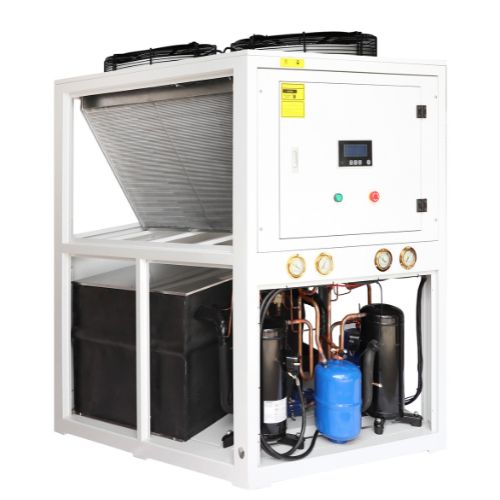
It is cooled through the classic vapor compression cycle system. It contains certain refrigeration components. Depending on the cooling method, it can be either air-cooled or water-cooled, meeting various scale requirements from research and development to mass production. On your production line, it provides large cooling capacity and base cooling for core equipment such as etching and thin film deposition.

The working principle of this chiller is based on the Peltier effect. When powered on, one end of the device cools while the other end heats up. The cooling mode can be quickly switched by changing the current direction. Its core advantage is no moving parts, no vibration, and an extremely fast response. In your semiconductor process, it is always applied for applications such as spray heads of coating and developing machines, and precision inspection equipment that require local temperature sensitivity and cleanliness, and quietness.
This system eliminates the intermediate coolant (such as water), allowing the chiller to evaporate and absorb heat directly in the cooling plate or cavity of your equipment. This “zero thermal resistance” design improves heat exchange efficiency and temperature control accuracy. The chiller can handle sudden high heat loads in etching processes and help achieve better etching rates and linewidth control.

It cools the condenser by driving air with an internal fan, dissipating the heat into the surrounding environment. The structure of the air-cooled chiller is relatively integrated, and installation is relatively simple. For you, if your factory space or water resources are limited, and the cooling load is not extremely demanding, you can choose this chiller. It is a flexible and actual choice for supporting some test equipment or environmental control.

It removes heat from the condenser through a cooling water circulation, usually requiring a connection to a cooling tower. Due to the higher thermal conductivity of water, it can handle very large heat loads. If your semiconductor process requires extremely strict temperature fluctuations (such as ±0.1°C) in lithography, large-scale mass production stages, it is a reliable foundation for ensuring process stability.
Reliable Certification


Application in the Semiconductor Industry
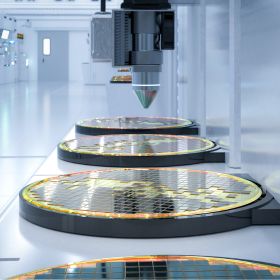
- Lithography: The cooler maintains a constant temperature for the laser source, projection lens, and wafer stage to prevent minute thermal expansion from causing nano-scale deviations in the lithography patterns, which directly affects the accuracy of pattern transfer.
- Etching and deposition: In plasma etching and chemical vapor deposition (CVD) processes, the temperature of the reaction chamber directly influences the etching rate and film uniformity. The cooler helps stabilize the process conditions, thereby achieving more consistent processing results.
- Cleaning and polishing: In the wafer cleaning and chemical mechanical polishing (CMP) stages, the cooler maintains the temperature of the cleaning solution and polishing solution stable, which can optimize cleaning efficiency and control the reaction rate during the polishing process, protecting the surface quality of the wafer.

- Improve test efficiency and accuracy: High-performance chip testing systems (such as aging tests and performance tests) generate a lot of heat. Excessive heat can cause the test speed to slow down or even result in incorrect outcomes. Coolers can promptly remove the heat, allowing your testing equipment to operate at the set temperature at full speed and reliably.
- Handle extreme temperature tests: When conducting high and low temperature reliability tests, coolers can quickly and accurately adjust the chip environment to extreme temperatures (such as -45°C to -90°C) to test their performance boundaries in practical applications.
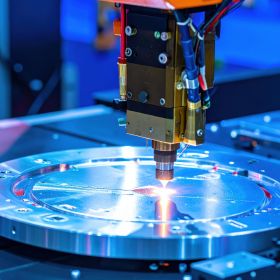
- Stabilize output wavelength: The output wavelength of the laser will drift with temperature (for example, about 0.1 nanometer/°C). In systems like wavelength division multiplexing (WDM), even a small wavelength offset can cause signal interference. Coolers keep the laser temperature constant for you, which locks in the accuracy of the optical signal.
- Ensure power and lifespan: Temperature increase will cause the laser output power to decrease and the threshold current to rise. Long-term overheating will also shorten the device’s lifespan. Effective cooling enables your laser to operate at its best for a longer period.
See the Semiconductor Chiller in Action
Watch how the semiconductor chiller delivers stable temperature control, fast cooling response, and reliable performance in real industrial working conditions.
Why Does the Semiconductor Industry Need Chillers?
Semiconductor manufacturing is extremely sensitive to temperature. Core processes like lithography and etching require temperature to be controlled within a range of ±0.1°C, or even
a more stringent range, to avoid product defects and reduced yield. Compared to ordinary industrial chillers, it can make ultra-high precision in temperature control, and meet the requirements of a clean room for low vibration and low noise. It can be customized for different processes (like wafer processing, laser applications), guaranteeing that key equipment (like lasers, vacuum systems) can operate stably for a long time in a thermal management environment.
The basic principle of the semiconductor chiller:
Its core consists of a compression refrigeration cycle involving four components:
- Compressing: The compressor sucks in the low-temperature and low-pressure refrigerant gas and condenses it into a high-temperature and high-pressure gas, preparing for heat release.
- Condensation: The hot and high-pressure gas releases its heat to the external environment, and then condenses into a high-pressure fluid.
- Swelling: The high-pressure refrigerant flows through the expanding valve, where the pressure and temperature drop sharply, turning into a mixture of low-temperature and low-pressure gas and liquid.
- Evaporation: This mixture absorbs the heat from the cooling liquid of your equipment, evaporates into a gas, and completes the cooling process. The heated gas is then sucked back into the compressor, and the cycle begins again.
Advantages of Chillers for Semiconductor
Precise temperature control
The semiconductor cooler provides ±0.1°C temperature stability. In processes such as lithography or ion implantation, any minor thermal fluctuations can lead to nanoscale drift in physical dimensions. The cooler continuously resists external interference through efficient thermoelectric technology and advanced PID microprocessors, ensuring absolute stability of reaction conditions and directly influencing the consistency of chip performance.
Efficient and energy-saving operation
The series design of screw-type and vortex-type compressors allows for automatic switching of operation based on your actual heat load, avoiding long-term fatigue of a single unit. Combined with a continuously variable-speed fan and pump, the system’s power consumption can be dynamically matched to the production line status. During partial load conditions, it can reduce energy waste and directly lower your long-term operating electricity costs. The modular design uses environmentally friendly refrigerants, eliminating the high costs and compliance risks associated with handling special cooling agents.
Sturdy and durable
The hydraulic circuit adopts an integrated 304 stainless steel tube, which almost eliminates the risk of joint leakage caused by vibration. The dedicated printed circuit board (PCB) significantly reduces electrical faults such as short circuits and oxidation. The application of magnetic drive non-sealed pumps and optical cavitation sensors jointly protects the core components of the pump. If your production line operates non-stop throughout the year, these designs enable the cooler to handle this demanding requirement with ease.
Intelligent Adaptation
The multi-channel electronic sensors built into it can continuously monitor key parameters such as temperature, pressure, water quality (such as deionization rate), and the data can be directly connected to your plant monitoring system. With a wide range of adjustment capabilities, the same equipment can flexibly support your different devices and scenarios. Through active data monitoring, it helps you manage risks in advance.
Easy Maintenance and Quick Repair
The patented sliding refrigeration skid-mounted components allow you to remove the entire refrigeration module for maintenance or replacement without having to cut the complex copper pipes, significantly shortening the critical repair time. The unique condenser maintenance door makes cleaning and inspection accessible. The quick connection ports with valves simplify the process of emptying and filling the water tank. These designs together shorten the average repair time and directly improve the overall equipment utilization rate of your production line.
It offers ±0.05°C level of temperature stability, cleanroom compatibility, and lower vibration, meeting the strict thermal management requirements of semiconductor processes and directly affecting product yield.
Because processes such as lithography and etching are carried out at the nanoscale, even a tiny fluctuation of 0.1°C can cause misalignment of the pattern or uneven film, resulting in product defects.
It mainly depends on the load, space, and process. Water-cooled type is selected for core processes with large load; TEC (Thermoelectric Cooling) type is selected for local precise temperature control; air-cooled type is selected when water source is limited; direct cooling can be used if there is a central water system.
Mainly electricity costs and maintenance. An efficient design combined with intelligent control can directly reduce energy consumption, while reliable components minimize unexpected downtime and replacement costs.
Regularly clean the filter and check the coolant. Pay attention to the sensor data and use its patented design’s convenient maintenance function to complete the maintenance quickly.


 English
 Spanish
 Arabic
 Vietnamese

